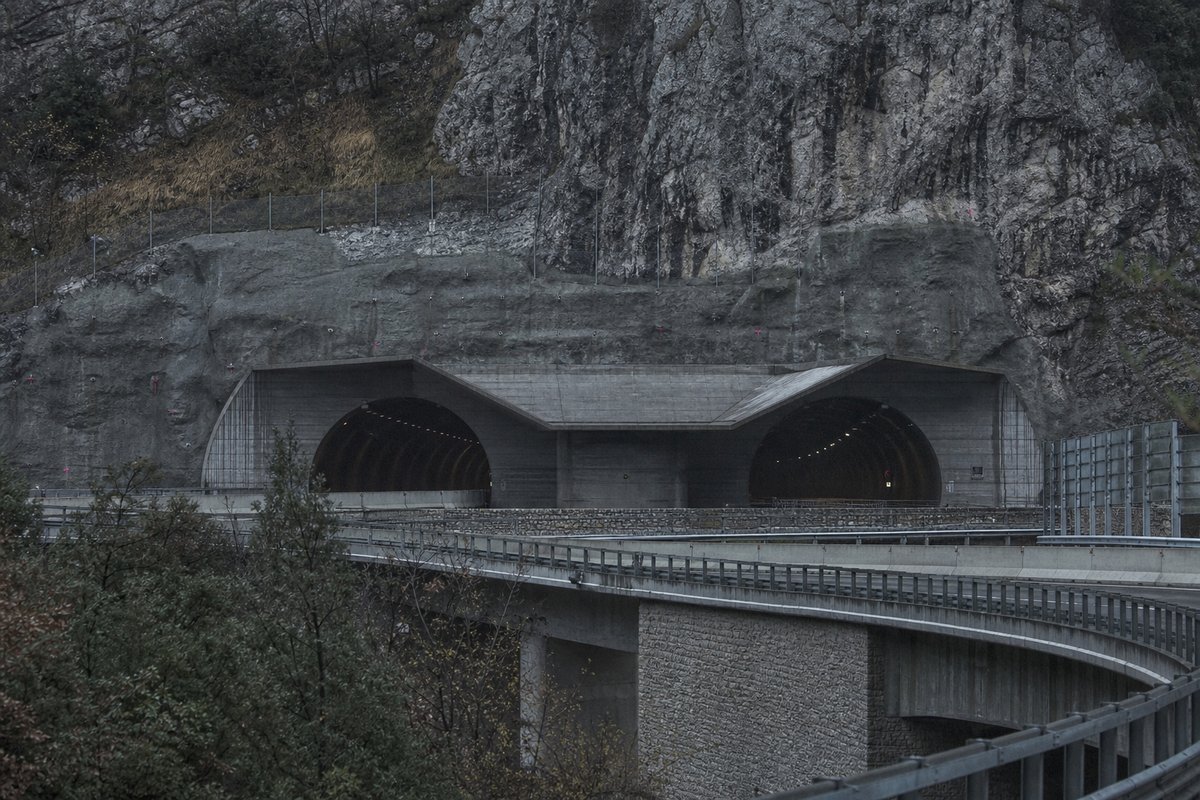
A tunnel list for Italy reads differently from a neighbouring country's, because the same journey time can be bought with one long bore in one country and a dozen short ones in another. Emergency lay-bys are spaced by regulation rather than by geometry, which is why they appear at intervals the alignment does not explain.
The cheapest kilometre of a route is the one already built, which is why upgrades follow old alignments even when a new one would be shorter. Swelling clays take up water and press on the invert for years after a tunnel opens, so some linings are designed to yield rather than resist.
Furlo is recorded in this archive at 3.39 km, opened in 1991, on the list it belongs to rather than only on this page. Tunnel openings arrive in waves, not at a steady rate, because contracts along a corridor are usually let together once a route has been funded.
How this archive measures: lengths, bores, dates and ordering
How this archive is compiled
This page records the structures catalogued for Italy in a tunnel almanac maintained at this address since the late 1990s. Tunnel building in Italy is shaped by geology and settlement pattern as much as by transport policy. Reconstruction after a fire changes the ventilation and the escape arrangement, and often the recorded length as well.
The first railway tunnels were driven by hand and gunpowder, and their alignments still carry the marks of both. Rock temperature rises with depth, and on the deepest alpine crossings the working face has needed cooling before it needed lighting. The fires of the late 1990s and early 2000s reshaped European tunnel safety regulation permanently.
Ventilation shafts allow a longer bore to be built, and their absence is often what caps a tunnel's length. Transverse ventilation gives every section its own supply and extract, which is why the long two-lane crossings have a false ceiling. Linings are inspected on a cycle measured in years and repaired in windows measured in hours.
China's list grew faster in twenty years than most national lists did in a century, and its longest entries are all recent. Immersed tube construction is used where the crossing is short and the water shallow enough to dredge a trench. Two headings driven towards each other halve the programme and double the survey problem.
Toll revenue on a fixed link is usually pledged against the debt that built it, and the toll ends when the debt does. Older entries were compiled from printed sources and correspondence, not from online publication. Environmental consent now takes longer than construction on many schemes, and the dates in a list rarely show it.
Reading the figures
Tunnels built for one purpose are regularly repurposed for another, and a disused rail bore is the commonest cycleway in some countries. Fixed links change settlement patterns, so the traffic a crossing carries after ten years is not the traffic it was justified on. A referendum has stopped more alpine schemes than geology has.
A tunnel outlasts the traffic it was designed for, and most of the cost after opening is ventilation and lighting rather than structure. A short bore in a city can cost more than a long one in a mountain, because the expensive part is what sits above it. Cross-passage spacing, not bore length, is what modern safety regulation actually governs.
Route numbering changes over time, so a road reference in the table reflects the designation at the time of recording. Smoke behaves differently on a gradient, and the uphill portal of a burning tunnel is the dangerous one. Iceland's tunnels are short, recent and almost all built to replace a road that closed in winter.
Nineteenth-century tunnels were surveyed from the surface with theodolites and chains, and the best of them met within centimetres. Jet fans hung from the crown are cheap to add and are the usual retrofit when traffic outgrows the original design. The oldest crossings still in service were built before any of the design codes that now govern their maintenance.
A tunnel is funded on a traffic forecast and judged on a construction cost, and the two are rarely revisited together. A railway tunnel is sized by the loading gauge, and a bore built for one country's rolling stock can refuse another's. Norway builds more subsea road tunnels than anywhere else because its coast is deep, its islands are populated and a bridge would not reach. Metro tunnels are shallow, closely spaced and built under streets, which makes them a different engineering problem from an alpine crossing.
Questions about Italy
How long is Furlo?
3.39 km, opened in 1991, on the figure this archive records for it. The full row, with the road reference and the administrative area, sits on the list this structure belongs to.
What counts as one structure on this page?
A single continuous bore between its own portals. Where a route is made up of several consecutive tunnels each is listed on its own row and not summed into one headline figure, so a motorway whose separate tunnelled sections are added together elsewhere appears here as its individual structures.
How is the Italy material sourced?
From the operator or the administration responsible for Italy, cross-checked against a second published figure where the two disagree. The measurement and dating conventions that apply across the whole record are set out once on the method page, not repeated here.
Other pages in this section
- Structures on the A1 var: the Variante di Valico, Bologna to Firenze
- Tunnels and Viaducts on the A01 Motorway in Italy, by Kilometre Point
- Tunnels and Viaducts on the A02 Motorway in Italy, by Kilometre Point
- Tunnels and Viaducts on the A03 Motorway in Italy, by Kilometre Point
- Tunnels and Viaducts on the A04 Motorway in Italy, by Kilometre Point
- Tunnels and Viaducts on the A05 Motorway in Italy, by Kilometre Point
- Tunnels and Viaducts on the A06 Motorway in Italy, by Kilometre Point
- Tunnels and Viaducts on the A07 Motorway in Italy, by Kilometre Point
- Tunnels and Viaducts on the A08 Motorway in Italy, by Kilometre Point
- Tunnels and Viaducts on the A09 Motorway in Italy, by Kilometre Point
- Tunnels and Viaducts on the A10 Motorway in Italy, by Kilometre Point
- Tunnels and Viaducts on the A11 Motorway in Italy, by Kilometre Point
- Tunnels and Viaducts on the A12 Motorway in Italy, by Kilometre Point
- Tunnels and Viaducts on the A13 Motorway in Italy, by Kilometre Point
- Tunnels and Viaducts on the A14 Motorway in Italy, by Kilometre Point
- Tunnels and Viaducts on the A15 Motorway in Italy, by Kilometre Point
- Tunnels and Viaducts on the A16 Motorway in Italy, by Kilometre Point
- Tunnels and Viaducts on the A18 Motorway in Italy, by Kilometre Point
- Tunnels and Viaducts on the A19 Motorway in Italy, by Kilometre Point
- Tunnels and Viaducts on the A20 Motorway in Italy, by Kilometre Point
- Tunnels and Viaducts on the A21 Motorway in Italy, by Kilometre Point
- Tunnels and Viaducts on the A22 Motorway in Italy, by Kilometre Point
- Tunnels and Viaducts on the A23 Motorway in Italy, by Kilometre Point
- Tunnels and Viaducts on the A24 Motorway in Italy, by Kilometre Point
- Tunnels and Viaducts on the A25 Motorway in Italy, by Kilometre Point
- Tunnels and Viaducts on the A26 Motorway in Italy, by Kilometre Point
- Tunnels and Viaducts on the A27 Motorway in Italy, by Kilometre Point
- Tunnels and Viaducts on the A28 Motorway in Italy, by Kilometre Point
- Tunnels and Viaducts on the A29 Motorway in Italy, by Kilometre Point
- Tunnels and Viaducts on the A30 Motorway in Italy, by Kilometre Point
- Tunnels and Viaducts on the A31 Motorway in Italy, by Kilometre Point
- Tunnels and Viaducts on the A32 Motorway in Italy, by Kilometre Point
- Tunnels and Viaducts on the A33 Motorway in Italy, by Kilometre Point
- Tunnels and Viaducts on the A34 Motorway in Italy, by Kilometre Point
- Tunnels and Viaducts on the A35 Motorway in Italy, by Kilometre Point
- Tunnels and Viaducts on the A36 Motorway in Italy, by Kilometre Point
- Tunnels and Viaducts on the A4-A31-A27 Motorway, by Kilometre Point
- Tunnels and Viaducts on the A50 Motorway in Italy, by Kilometre Point
- Tunnels and Viaducts on the A51 Motorway in Italy, by Kilometre Point
- Tunnels and Viaducts on the A52 Motorway in Italy, by Kilometre Point
- Tunnels and Viaducts on the A58 Motorway in Italy, by Kilometre Point
- Tunnels and Viaducts on the A90 Motorway in Italy, by Kilometre Point
- Tunnels and Viaducts on the D08 Motorway in Italy, by Kilometre Point
- Tunnels and Viaducts on the D11 Motorway in Italy, by Kilometre Point
- Tunnels and Viaducts on the D15 Motorway in Italy, by Kilometre Point
- Tunnels and Viaducts on the D29 Motorway in Italy, by Kilometre Point
- Tunnels and Viaducts on the D29A Motorway in Italy, by Kilometre Point
- Traforo del Monte Bianco: the Mont Blanc Tunnel Reopened in 2002
- Tunnels and Viaducts on the R03 Motorway in Italy, by Kilometre Point
- Tunnels and Viaducts on the R04 Motorway in Italy, by Kilometre Point
- Tunnels and Viaducts on the R30 Motorway in Italy, by Kilometre Point
- Tunnels and Viaducts on the R33 Motorway in Italy, by Kilometre Point
- Tunnels on the Italian State Roads SS 100 to SS 199, Listed by Route
- Tunnels and Viaducts on the S.S. 125 var, Cagliari to Tortoli
- Tunnels and Viaducts on the SS33 Motorway in Italy, by Kilometre Point
- Tunnels and Viaducts on the SS340 in Italy, by Kilometre Point
- Tunnels and Viaducts on the SS36 Motorway in Italy, by Kilometre Point
- Tunnels and Viaducts on the SS38 Motorway in Italy, by Kilometre Point
- Tunnels and Viaducts on the TEM — Tangenziale Esterna Est Milano
- Motorways' Chronology in Italy — Section Openings Listed by Date
- Motorways in Italy, Page 2 — Tunnels and Viaducts by Kilometre Point
- Motorways in Italy — the Numbering Scheme, Routes and Structures
- Road Tunnels in Italy — Complete List by Length, Part 1000
- Road Tunnels in Italy — Complete List by Length, Part 750
- Road Tunnels in Italy — Complete List by Length
Cite this page
The Furlo Tunnel in Italy: Portals, Photographs and Setting. The World's Longest Tunnels. https://www.lotsberg.net/data/italia/furlo.html
Related record tables
- BART Tunnels and Tubes in the San Francisco Bay Area
- The Salang Tunnel in Afghanistan: Road and Galleries
- The Perisher Blue Skitube: a Rack Railway in Australia
- Tunnels and Viaducts on the A8 Motorway in France
- Tunnels and Viaducts on the A43 Motorway in France
- Structures on the A51 Motorway in France
- Der Alte Elbtunnel: the Old Elbe Tunnel in Hamburg
- Structures on the A1 var, Variante di Valico, Italy
- Tunnels and Viaducts on the A01 Motorway in Italy
- Tunnels and Viaducts on the A02 Motorway in Italy
- Tunnels and Viaducts on the A03 Motorway in Italy
- Tunnels and Viaducts on the A04 Motorway in Italy