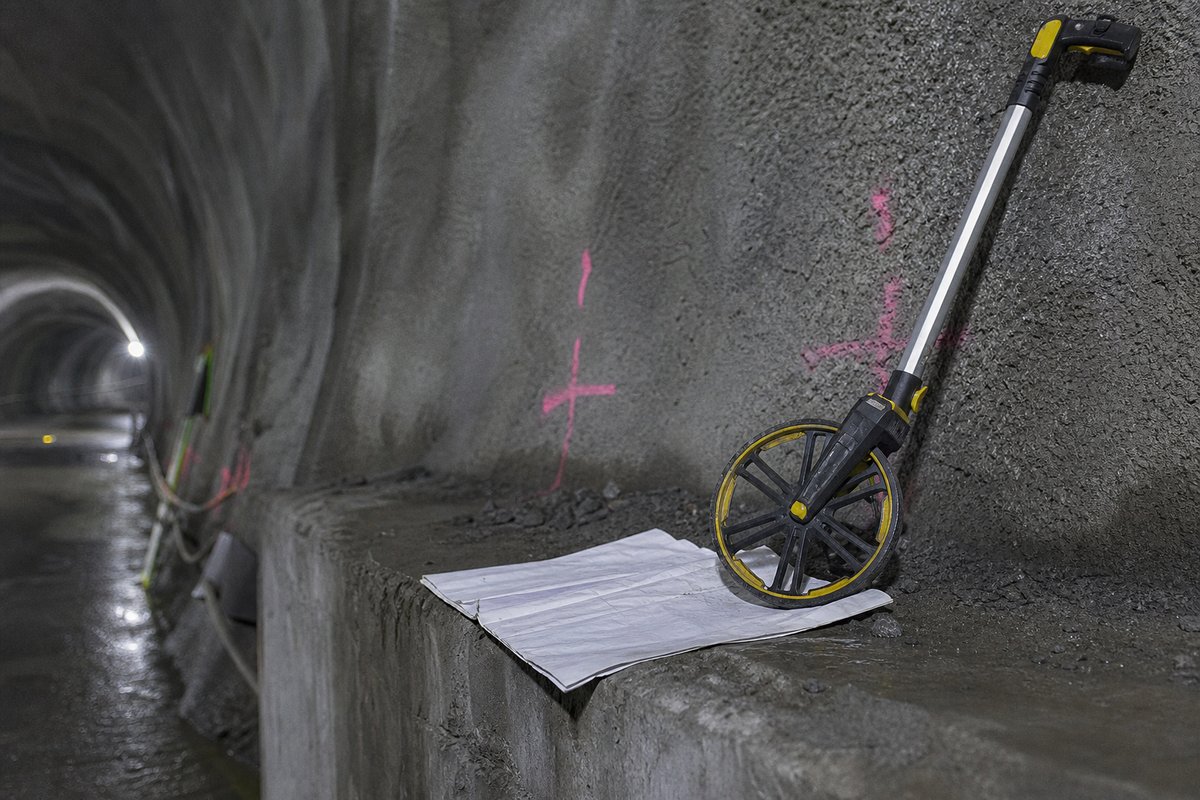
Every length on this site is portal to portal along the carriageway or the track centre line, in metres, as published by the operator or the responsible administration. Metres are used throughout, because that is the unit tunnelling contracts and portal plaques are written in. Published lengths for the same structure often differ by a few metres between sources, because one may measure to the portal face and another to the end of the cut-and-cover approach. Cut-and-cover sections at either end are frequently counted differently by different administrations, and that is the usual reason two published figures disagree.
Where a crossing consists of several consecutive bores, each is listed separately rather than summed into a single headline figure. A motorway whose tunnelled sections are added together into one number is therefore listed here by its individual bores, which is why some widely quoted figures do not appear. Service and escape galleries running parallel to a main bore are not counted as separate tunnels. The distinction between a tunnel and a covered cutting is not consistent between countries, and it affects the shorter entries more than the long ones.
Twin-tube crossings frequently show two slightly different lengths, since the two carriageways rarely follow exactly the same alignment through the rock. Opening dates refer to the date traffic was admitted, not to breakthrough or to completion of the civil works, which normally fall one to two years earlier. Structures under construction are shown separately from those open to traffic, and a bore that has not opened can never hold a record. Where a figure could not be established from a published source the cell is left blank rather than filled with an estimate.
How this archive is compiled
Length is the dimension published most consistently across borders, which is why it governs the ordering, but it is a poor proxy for how hard a tunnel was to build. Geology decides cost and programme far more than distance does; a short bore through squeezing ground can take longer than a long one through sound rock. Structures below the reporting threshold used by the responsible administration do not appear, which is why short galleries are absent from most national lists. On a narrow screen every table reflows into labelled blocks, so no column has to be scrolled sideways to be read.
Figures are compiled from operator and ministry publications, national road and rail administrations, and the engineering trade press, and checked against one another where they disagree. The compilation began as a private record in the late 1990s and has been assembled from primary sources rather than from secondary summaries. Where a table has been re-checked, the sources consulted for the rows that changed are listed at the foot of that page. A record that rests on general reference works rather than on an operator or an administration is described as such, because the distinction matters more than the number of citations.
No figure here is estimated, interpolated or inferred from a neighbouring structure; an unknown length stays unknown. Rankings are not curated: a table carries every entry that meets the inclusion rule, not a selected top ten, because the tail is where most of the engineering interest sits. Nothing on any page is a paid placement or an exchange, and no external reference was solicited. Corrections are welcome against a published source, and a corrected figure carries the date it was last checked.
Reading the figures
Questions about this record
Why do two sources give different lengths for the same tunnel?
Because they measure to different points. One may stop at the portal face and another at the end of the cut-and-cover approach, and administrations differ on whether the approach counts. Where sources disagree the figure published by the operator or the responsible administration is the one recorded.
Why is a well-known 'longest tunnel' missing from a table?
Usually because the widely quoted figure sums several separate bores along one route. Each bore is listed here on its own row, so the route appears as its parts rather than as one number.
Are tunnels under construction included?
They are listed, but held apart from the structures open to traffic and never treated as record holders. A projected opening year is a forecast, and on schemes of this size forecasts move.
What does a blank cell mean?
That no figure could be established from a source meeting the standard used here. Blank means unknown; it never means zero, and it is preferred to an estimate.
Cite this page
How this archive measures: lengths, bores, dates and table order. The World's Longest Tunnels. https://www.lotsberg.net/method/index.html