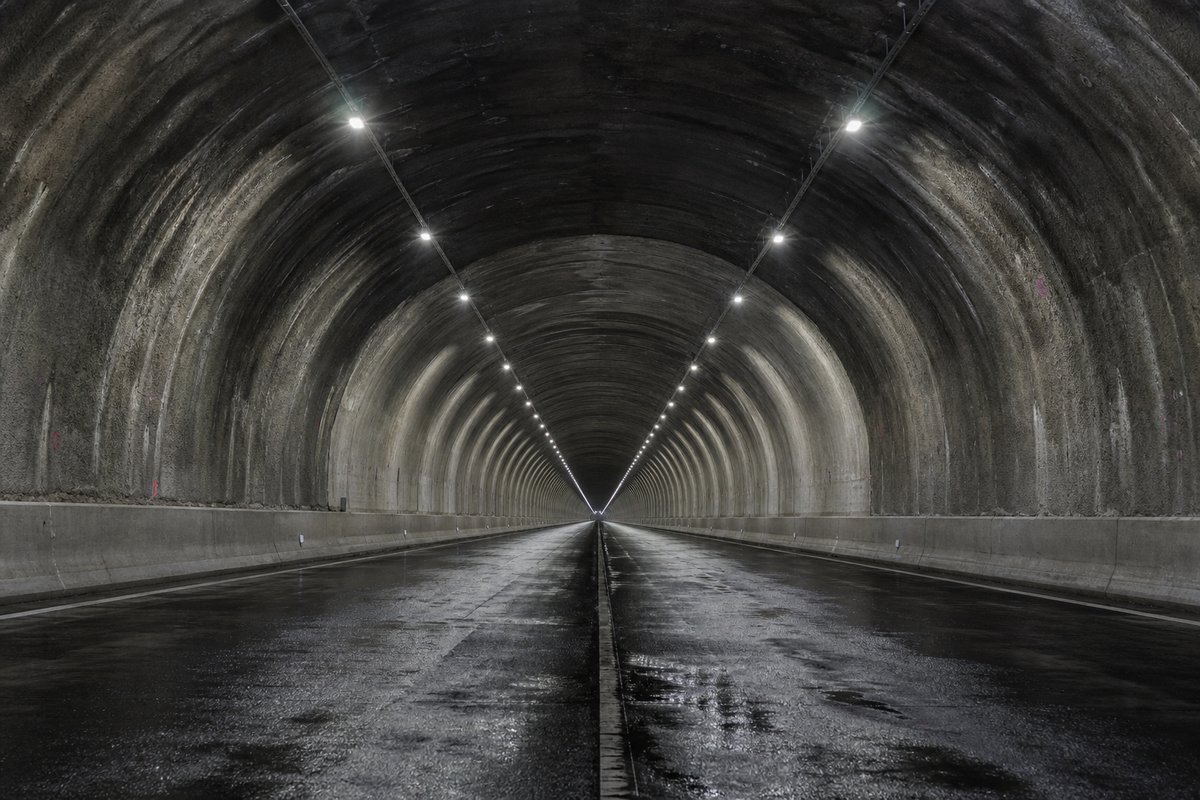
The ordering gives longest road tunnels in the world by length, which is the comparison most readers arrive wanting. This page is the full reference table, not a top ten, and it carries every entry that meets the inclusion rule. Length is recorded in metres for every entry, and length alone decides the sort order.
The tail of the distribution is where most of the engineering interest sits, which is why nothing is trimmed from the bottom of the list. A list of longest road tunnels in the world is only as good as its sourcing, and each figure here comes from an operator or an administration.
What follows is a list of longest road tunnels in the world and not a selection, with every row traceable to a published source. The median entry measures 12.46 km, so half the table sits below that and half above, which is a better guide to the typical structure here than the headline figure.
- 49entries listed
- 24.51 kmlongest bore
- 1965–2025openings span
- 645.93 kmtotal length
The longest road tunnels in the world, ranked by length
Figures on this page were last checked against operator and administration sources on 2 September 2026.
Ranked by bore length. Only continuous bores open to general road traffic are counted; a motorway whose tunnelled sections are summed into one figure is listed by its individual bores instead.
How this archive measures: lengths, bores, dates and ordering
| Country | Tunnel | Length | Date of opening |
|---|---|---|---|
| Norway | Laerdal | 24 510 m | 27.11.2000 |
| China | Tianshan Shengli (2 tubes) | 22 130 m | 26.12.2025 |
| Japan | Yamate | 18 200 m | 07.03.2015 |
| China | Zhongnanshan (2 tubes) | 18 040 m | 20.01.2007 |
| China | Jinpingshan (2 tubes) | 17 504 m 17 483 m | 2011 |
| Switzerland | St. Gotthard / San Gottardo | 16 942 m | 05.09.1980 |
| China | Tiantaishan | 15 560 m | 2021 |
| Austria | Arlberg (Length in 1978: 13 972 m) | 15 516 m | 01.12.1978 |
| China | Daliangshan No. 1 | 15 366 m | 2025 |
| China | Muzhailing | 15 226 m | 2024 |
| Turkey | Zigana | 14 476 m | 2023 |
| Norway | Ryfylke. Subsea tunnel near Stavanger. Start of work 2013 (2 tubes) | 14 459 m | 30.12.2019 |
| Turkey | Ovit | 14 346 m | 13.06.2018 |
| China | Micangshan (on Bazong - Shaanxi Expressway, 2 tubes) | 13 833 m 13 792 m | 2018 |
| China | Dabashan | 13 715 m | 2025 |
| China | Xishan | 13 654 m | 2012 |
| China | New Erlangshan (on Yaan - Kangding Expressway, 2 tubes) | 13 433 m 13 381 m | 2018 |
| China | Shiziping | 13 156 m | 2020 |
| China | Hongtiguan (on Changzhi - Pingshun Expressway) | 13 122 m 13 098 m | 2013 |
| China | Baima | 13 010 m | 2025 |
| Taiwan | Hsuehshan (twin tunnel + service) | 12 942 m | 16.06.2006 |
| France - Italy | Fréjus | 12 898 m 12 878 m | 12.07.1980 2019 |
| China | Guigala | 12 790 m | 2024 |
| China | Daliangshan No. 2 | 12 475 m | 2024 |
| Singapore | KPE / MCE Expressway | 12 460 m | 2013 |
| China | Gaoloushan | 12 334 m | 2024 |
| China | Maijishan (on Baotian (Baoji - Tianshui) Expressway, 2 tubes) | 12 288 m 12 286 m | 2009 |
| China | Daxiagu | 12 146 m | 2023 |
| China | East Tianshan | 11 775 m | 2021 |
| France - Italy | Mont-Blanc / Monte Bianco | 11 611 m | 19.07.1965 |
| China | Laoying | 11 515 m | 2021 |
| China | Chengkai | 11 489 m | 2022 |
| Norway | Gudvanga | 11 428 m | 17.12.1991 |
| China | Yunshan (Shanxi-Hefen Expressway) | 11 408 m 11 377 m | 30.12.2015 |
| China | Yingpanshan | 11 310 m | 2022 |
| Faroe Islands | Eysturoy (subsea, roundabout at -187 m) | 11 240 m | 19.12.2020 |
| China | Baojiashan (on i'An - Angkang Expressway, 2 tubes) | 11 200 m 11 195 m | 28.05.2009 |
| China | Huzhubeishan | 11 171 m | 2025 |
| Norway | Folgefonn | 11 150 m | 15.06.2001 |
| Japan | Kan-etsu (south bound tube) Kan-etsu (north bound tube) | 11 055 m 10 926 m | 1991 1985 |
| China | Gaoloushan | 10 875m | ? |
| Japan | Hida (+emergency tunnel) | 10 712 m | 5.07.2008 |
| Norway | Toven | 10 665 m | 22.11.2014 |
| China | Baotashan (on Pingyao - Yushe Expressway, 2 tubes) | 10 480 m 10 192 m | 2012 |
| Italy | Gran Sasso d'Italia (East direction) (West direction) | 10 176 m 10 173 m | 01.12.1984 1995 |
| Austria | Plabutsch (West tube) | 10 085 m | 17.12.2004 |
| Norway | Jondal | 10 050 m | 7.09.2012 |
| China | Nibashan (on Yaan - Xichang Expressway, 2 tubes) | 10 007 m 9 962 m | 2012 |
| France | Duplex A86 | 10 000 m | 8.01.2011 |
Measuring length, and why sources disagree
The table below lists 49 entries with a recorded length, each giving a name, a length in metres and, where documented, the year of opening. The middle half of the table runs from 11.19 km to 14.4 km, and that band is where most of the engineering on this page actually sits.
The entries sum to roughly 645.93 km of bore, an average of about 13.18 km each, though that average describes no actual row. The three longest entries alone account for 64.84 km of the 645.93 km on this page, which is 10 per cent of the total from 3 of 49 rows.
Roughly 41 of the dated entries opened in this century, which is a rough measure of how much of the network is recent. Lengths for the world are recorded in metres which is how the operators publish them and why the shortest entry here reads as 10 000 m and not a rounded figure.
Between the longest and the tenth-longest the drop is 9.28 km, which is the part of the table that changes when a single scheme opens. Where one of these 49 lengths disagrees with an operator's own figure for the world, the table keeps the published value and notes the difference instead of averaging the two.
A new scheme in the world would have to beat 24.51 km to change the head of this table, and that is the figure worth rechecking when one opens. 43 of the 49 entries fall within a quarter of the median length, which is how tightly this particular list clusters around its typical structure.
How the ranking is ordered
The 49 rows for the world are ordered by length, not by date, so the 2025 opening sits well down the table without being any less current. The longest entry is 2.5 times the shortest and 2.0 times the median, which is the quickest measure of how uneven the table is.
Readers who want longest road tunnels in the world by length and not a curated shortlist will find exactly that here. Where a figure could not be sourced the cell is left blank, so what is shown is measured and nothing is inferred. Opening dates before 1900 are shown as published, since sources frequently disagree.
33 of the dated entries opened from 2010 onwards, which shows how much of what is listed here is recent construction and not historic work. Eighth on the list is Arlberg at 15.52 km, which is where the table stops being about record holders and starts being about ordinary infrastructure.
Sorting on that one dimension is imperfect, since geology decides difficulty, but it is the measure published consistently enough to rank on. Treat the table as the argument and the prose as the footnote: the numbers carry the case. Anyone comparing these figures across borders should read the note column too, since national practice varies.
Opening dates and what they refer to
The dated entries fall across 26 different years, which is a rough measure of whether this was a sustained programme or a handful of separate schemes. The ten longest average 17.9 km against 11.97 km for everything below them, and that ratio is the clearest thing this table says about the distribution.
This page records the road tunnels catalogued for the world in a tunnel almanac maintained at this address since the late 1990s. Laid end to end the entries on this page would run 645.93 km, which is a number with no engineering meaning but a useful sense of the scale of what is catalogued.
Reading a list of longest road tunnels in the world
Nothing in this table is estimated: where a value could not be sourced it is left blank. Read down the length column, the 37 values run from 10 000 m to 24 510 m with a midpoint at 12 475 m; the spread rather than the maximum is what says how uneven this set is.
Second and third place go to Tianshan Shengli at 22.13 km and Yamate at 18.2 km. The material on this page is held in 23 captions rather than in running text, 155 words of it, each written against the image or row it belongs to by the compiler who put the page together.
Further down the table, Jinpingshan is recorded at 17.5 km and St. Gotthard / San Gottardo at 16.94 km. The table on this page runs to 49 rows and records Country, Tunnel, Length and Date of opening for each of them, which is the shape the original compiler chose rather than one imposed here.
The shortest recorded entry is 10 km against 24.51 km at the top, a spread of 2.45x across the same table. The captions name 18 distinct places and structures — Expressway, Yaan and Length among them — and those names are the index into the length tables where each is recorded with its own figure.
2 entries sit within ten per cent of the longest, so the head of this record is a close group, not one structure standing clear. The tunnel column names 48 distinct entries on this page, Laerdal and Tianshan Shengli (2 tubes) among them, each traceable to the operator or administration record it was taken from.
Where two sources disagree on a length, the operator's own published length is preferred. Entries are ranked longest first, so the head of the table is the current record. The shorter half of the table totals 266.17 km against 379.76 km for the longer half, from the same number of rows.
A ranked list of this kind is only stable until the next large scheme opens. Opening dates are given for admission of traffic, not for breakthrough. After the 2020s the next busiest decade here is the 2010s with 15 openings, so the building effort came in more than one wave.
The longest entry is Laerdal, at 24.51 km, opened in 2000. Dated entries run from 1965 to 2025, and the busiest decade is the 2020s with 18 recorded openings. A concrete arch takes its load into the abutments, so it needs rock at both ends and appears where valleys are steep and narrow.
The longest stands 2.38 km clear of the next longest, which is the margin to watch when a new scheme is announced. 49 of the 49 measured entries exceed five kilometres, and those are the ones that carry a full ventilation and escape regime. Only bores open to general road traffic are counted here.
24 entries sit above the median and 25 at or below it, so the table is top-heavy and not clustered at one end. 49 entries reach ten kilometres and 2 reach twenty, a distribution that decides how much of this table needs full mechanical ventilation. The world ranking has changed repeatedly as new expressway schemes have opened.
Dates for the world refer to opening to traffic, not breakthrough, so the 1965 entry was under construction for some years before that. Openings average one every 1.3 years across the dated entries here, though they arrive in clusters, not at that rate. Mine adits, service galleries and tunnels restricted to a single operator are excluded.
The dated entries carry 26 distinct opening years across 60 years, and the median opening year is 2015. The earliest dated entry is Arlberg, opened in 1978, and the most recent is Tianshan Shengli in 2025. Rows are ordered by length, longest first, so the head of the table answers the question most readers arrive with.
The 2020s account for 18 openings here and the 2010s for 15, so the building effort was not spread evenly across the period. A tunnel is funded on a traffic forecast and judged on a construction cost, and the two are rarely revisited together. Traffic signals inside a tunnel exist to stop vehicles entering behind an incident, and they are the cheapest safety system on the list.
Karst limestone hides voids that no borehole pattern reliably finds, which is why crossings through it carry the largest contingencies. A subaqueous crossing is designed from the rock cover at the lowest point upward, and everything else follows from that number. Adding a metre to the longest tunnel in the world costs what adding a kilometre to an average one does.
Questions about World record table
What is the longest road tunnel in the world?
On the figures recorded here it is Laerdal, at 24.51 km, opened in 2000. It heads a table of 49 entries ordered by bore length, not by span, cost or construction difficulty.
How many road tunnels are listed for the world?
49 entries with a recorded length appear on this page, from 10 km at the short end to 24.51 km at the top, with the middle of the set around 12.46 km.
How far back do the opening dates go?
The earliest dated entry opened in 1965 and the most recent in 2025, so this page covers 60 years across 26 distinct opening years. A date here is the opening to traffic, which on these 48 dated rows is one to two years after breakthrough.
What is a typical length among the road tunnels listed for the world?
The median entry measures 12.46 km and the middle half of the table runs from 11.19 km to 14.4 km. The headline figure of 24.51 km is the outlier, not the norm, which is why the median is the more useful number when comparing one national list against another.
When were most of the road tunnels in the world built?
The busiest decade recorded here is the 2020s, with 18 openings, then the 2010s with 15, and 41 of the dated entries opened from 2000 onwards. That is 38 per cent of the 48 dated rows in a single decade, which says as much about when the route was funded as about the engineering.
Other pages in this section
- The European E-Road Network — 113 Recorded Entries
- Alpine Road and Railway Tunnels by Length
- Navigation Canal Tunnels by Length, Part 2 — a Ranked Reference List
- The Longest Canal Tunnels: Historic Navigation Routes by Length
- The World's Highest Tunnels — 11 Recorded Entries
- The Oldest Road and Rail Tunnels Still in Use
- Rack Railways of the World — 18 Recorded Entries
- The Longest Railway Tunnels in the World by Length and Opening Dates
- Railway Tunnels Longer Than 3000 Metres — a Ranked Reference List
- Railway Tunnels Longer Than 5000 Metres — a Ranked Reference List
- Railway Tunnels in Europe by Length — a Ranked Reference List
- Railway Tunnels in Europe by Length, Part 2 — a Ranked Reference List
- Subaqueous Road Tunnels: Subsea Bores and Immersed Tubes by Depth
- Road Tunnels Longer Than 4000 Metres — a Ranked Reference List
- Road Tunnels Longer Than 5000 Metres — a Ranked Reference List
Operators and administrations
- Fréjus sftrf.fr
- Hsuehshan (twin tunnel + service) news.bbc.co.uk
- St. Gotthard / San Gottardo afbn.ch
This page listed 9 external addresses; 3 of them still hold the material they were listed for and are shown above. The other 6 were checked against the content of the page each leads to, not merely its status code, and did not survive it.
Sources
Each row cross-checked against at least two of: the operator or national administration, the engineering trade press, and a general reference. Figures that could not be corroborated were not added.
- Tianshan Shengli — China Daily 26-27.12.2025; SCMP; Tunnels & Tunnelling International
- Yamate — Metropolitan Expressway Co (Shutoko); PIARC tunnel case study
- Ryfylke depth and length — Statens vegvesen; MIT Technology Review 22.06.2026
- Zigana, Ovit — Turkish General Directorate of Highways (KGM)
- Faroe subsea tunnels — Eystur- og Sandoyartunlar / Landsverk
Operators, national administrations, standards bodies and specialist journals are linked. Dated news items are named with their date rather than linked, because a link to a publication's home page is not a citation to an article. General reference works are named and not linked.
Cite this page
Longest Road Tunnels in the World, Ranked by Length with Opening Dates. The World's Longest Tunnels. https://www.lotsberg.net/data/tun10.html
Related record tables
- Alpine Tunnels — 5 Recorded Entries
- The World's Highest Tunnels — 11 Recorded Entries
- The Oldest Tunnels in the World
- Subaqueous Road Tunnels: Subsea Bores and Depth by Length
- Road Tunnels Over 4000 m — 98 Ranked by Length
- Road Tunnels Over 5000 m — 203 Ranked by Length
- Le gallerie più alte del mondo, per quota sul livello del mare
- Le gallerie più antiche del mondo ancora in servizio
- Le gallerie stradali più lunghe del mondo, per lunghezza
- Le gallerie subalvee più lunghe e più profonde del mondo
- Dei eldste tunnelane i verda som framleis er i bruk
- Dei høgaste tunnelane i verda, etter høgd over havet