A tunnel list for Afghanistan reads differently from a neighbouring country's, because the same journey time can be bought with one long bore in one country and a dozen short ones in another. A canal tunnel is sized by the boat, not by the traffic, which is why the oldest of them are so narrow.
The material on this page is held in 3 captions rather than in running text, 78 words of it, each written against the image or row it belongs to by the compiler who put the page together. Escape and rescue provision has driven most of the change in tunnel design over the past three decades.
They are not uniform: the fullest runs to 49 words and the briefest to 8, and on a page of this kind the long ones are where the explanation lives — the caption carries what the picture cannot. Tunnel building in Afghanistan is shaped by geology and settlement pattern as much as by transport policy.
The record table
How this archive measures: lengths, bores, dates and ordering
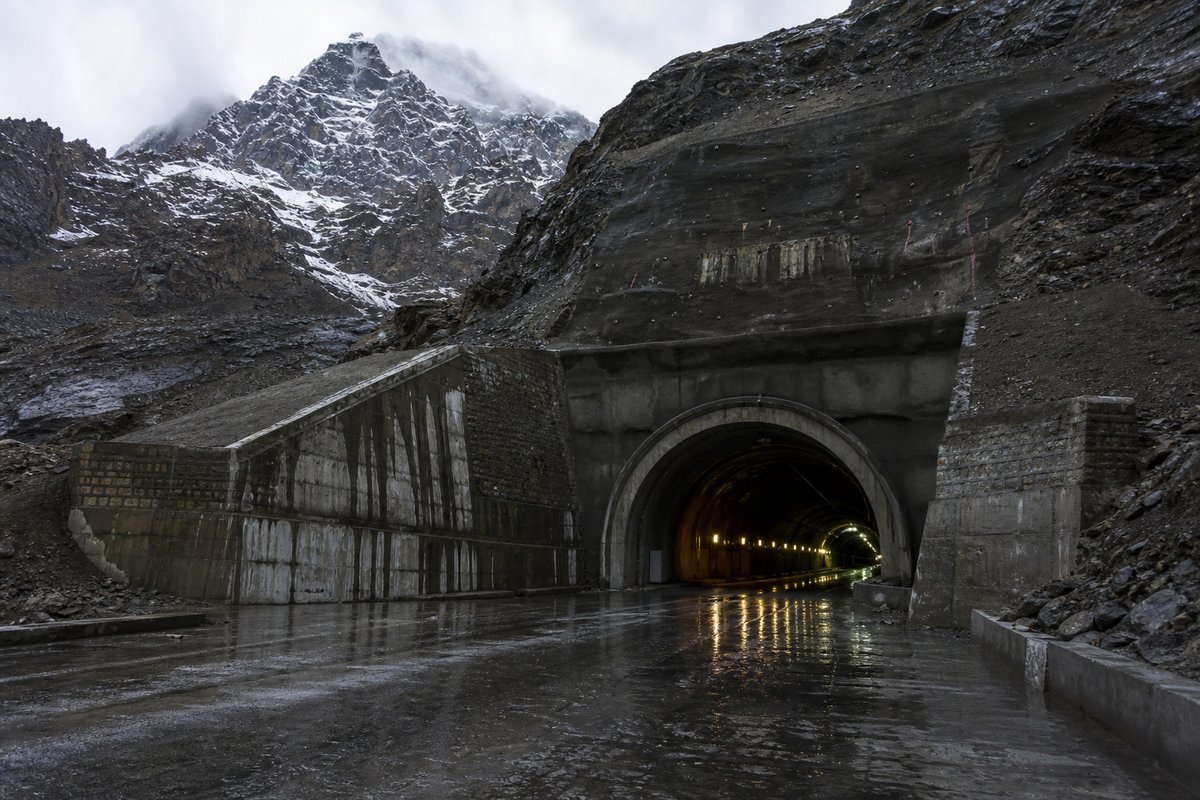
| — | South entrance May 2002 300 m of snow galleries and the ventilation building were destroyed by explosions in 1997. The road is open for one way traffic and the road standard is very low. The World bank is financing an emergency repair of the missing snow galleries 2002 - 2003. |
|---|---|
| Ventilators Pieces of the old fans can still be observed in the snow where they landed after the explosions in 1997. | |
| Danger! New fans will be installed in 2003 |
How this table is compiled
A viaduct is measured along its deck and a bridge by its main span, and confusing the two is the commonest error in a bridge list. A freight route's ruling gradient is set by the heaviest train it must lift, and that single figure decides whether a tunnel is needed at all.
Salang is recorded in this archive at 2.7 km, opened in 1964, on the list it belongs to rather than only on this page. Geology decides cost and programme far more than distance does; a short bore through squeezing ground can take longer than a long one through sound rock.
This page records the structures catalogued for Afghanistan in a tunnel almanac maintained at this address since the late 1990s. The tail of a list is where the ordinary infrastructure sits, and it is more representative of what gets built than the head is. A record is a statement about what has been published, not about what exists.
A tunnel boring machine produces a circular bore, which is why cross-section area and length do not scale together across entries. A disused tunnel is expensive to fill and cheap to seal, which is why so many survive behind a wall. The number of tubes is recorded because it changes both capacity and the safety regime that applies.
Wind, not weight, governs the design of a long-span bridge, and the deck section is shaped in a wind tunnel before anything is cast. Water management is the maintenance problem that never ends, and drainage design decides how expensive it will be. Smoke behaves differently on a gradient, and the uphill portal of a burning tunnel is the dangerous one.
Reading the figures
A scheme abandoned half-built leaves a heading that shows on no map and turns up during the next survey. Legging a boat through an unlined canal bore was normal practice for a century and left marks on the walls that survive. The first railway tunnels were driven by hand and gunpowder, and their alignments still carry the marks of both.
Sequential excavation takes the face in slices, which is slower per metre and far more tolerant of ground that changes. Route numbering changes over time, so a road reference in the table reflects the designation at the time of recording. Gradient inside a road tunnel is kept gentle for heavy vehicles, which lengthens the bore to gain the same height.
Traffic signals inside a tunnel exist to stop vehicles entering behind an incident, and they are the cheapest safety system on the list. Fixed links change settlement patterns, so the traffic a crossing carries after ten years is not the traffic it was justified on. Base tunnels replaced summit routes that climbed with spirals and switchbacks, and several of those older lines are still in place above them.
A national administration publishes what it maintains, so a crossing that changes owner can vanish from one list and appear in another. Tunnels built for one purpose are regularly repurposed for another, and a disused rail bore is the commonest cycleway in some countries. Water ingress is pumped out continuously on a subaqueous crossing, and the pumps are the one system that can never be off. A tunnel closed for maintenance is a route severed, so single-bore crossings are worked on at night and in short windows. The oldest entries in any national list are usually canal or rail, because roads were the last mode to need long bores.
Questions about Afghanistan
How long is Salang?
2.7 km, opened in 1964, on the figure this archive records for it. The full row, with the road reference and the administrative area, sits on the list this structure belongs to.
What counts as one structure on this page?
A single continuous bore between its own portals. Where a route is made up of several consecutive tunnels each is listed on its own row and not summed into one headline figure, so a motorway whose separate tunnelled sections are added together elsewhere appears here as its individual structures.
How is the Afghanistan material sourced?
From the operator or the administration responsible for Afghanistan, cross-checked against a second published figure where the two disagree. The measurement and dating conventions that apply across the whole record are set out once on the method page, not repeated here.
Cite this page
The Salang Tunnel in Afghanistan: Road, Snow Galleries, Ventilation. The World's Longest Tunnels. https://www.lotsberg.net/data/afghanistan/salang.html
Related record tables
- BART Tunnels and Tubes in the San Francisco Bay Area
- The Perisher Blue Skitube: a Rack Railway in Australia
- Tunnels and Viaducts on the A8 Motorway in France
- Tunnels and Viaducts on the A43 Motorway in France
- Structures on the A51 Motorway in France
- Der Alte Elbtunnel: the Old Elbe Tunnel in Hamburg
- The Mont Blanc Tunnel on the Day of Reopening, 2002
- Structures on the SS 125 var in Sardinia, Italy
- The Furlo Tunnel in Italy: Portals and Photographs
- Aqueduct and Water Conveyance Tunnels in Japan
- Hydropower and Headrace Tunnels in Nepal
- The Laerdal Tunnel: the World's Longest Road Tunnel