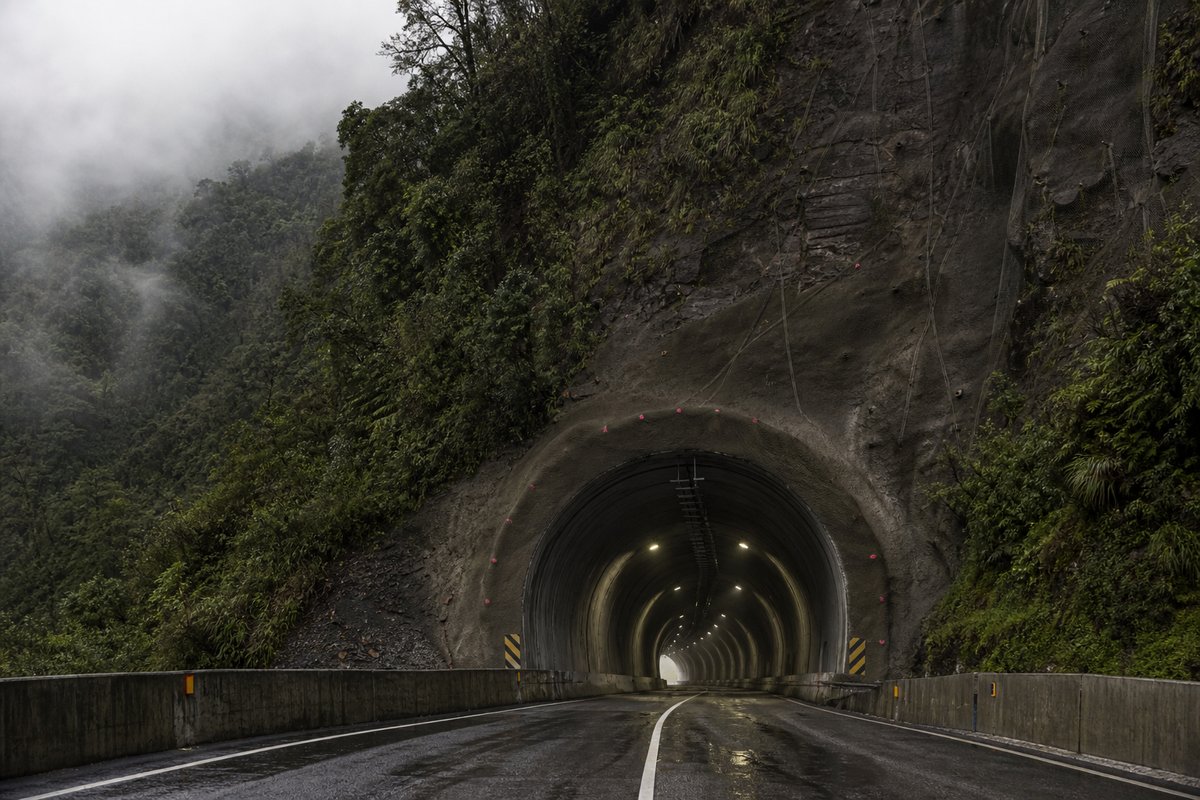
7 of those 9 are recorded as under construction or planned, the longest of them San Eduardo at 1.4 km, so the count includes them while every measured figure — the range, the median, the total — describes the 2 rows carrying traffic today: an unopened bore cannot hold a record.
Laid end to end the entries on this page would run 1.82 km, which is a number with no engineering meaning but a useful sense of the scale of what is catalogued. China's list grew faster in twenty years than most national lists did in a century, and its longest entries are all recent.
The table on this page runs to 9 rows and records Tunnel, Length, Year of opening, Province and Notes for each of them, which is the shape the original compiler chose rather than one imposed here. A scheme abandoned half-built leaves a heading that shows on no map and turns up during the next survey.
- 9entries listed
- 0.96 kmlongest bore
- 2003–2003openings span
- 1.82 kmtotal length
The record table
How this archive measures: lengths, bores, dates and ordering
| Tunnel | Length | Year of opening | Province | Notes |
|---|---|---|---|---|
| San Eduardo | 1 400 m | PRJ | G | Feasibility study |
| Guayaquil 1* | 1 330 m | U.C. | G | |
| Pinchincha South bound | 1 216 m | PRJ | Avenida Interoceanica. Quito - Valle de Tumbaco | |
| Puertas del Cielo | 960 m | Y | Banos - Puyo road | |
| Churosinguna - Machay | 860 m | 16.09.2003 | Y | Banos - Puyo road |
| Guayaquil 2* | 805 m | U.C. | G | |
| Rio Verde B | 650 m | U.C. | Y | Banos - Puyo road |
| Rio Verde A | 480 m | U.C. | Y | Banos - Puyo road |
| San Jorge | 300 m | U.C. | Y | Banos - Puyo road |
| — | Province | Main Town |
|---|---|---|
| O | El Oro | Machala |
| P | Pinchincha | Quito |
| R | Los Rios | Babhoyo |
| S | Morona - Santiago | Macas |
| T | Tungurahua | Ambato |
| U | Sucumbios | Nueveloga |
| W | Galapagos | San Cristobal |
| X | Cotopaxi | Latacunga |
| Y | Pastaza | Puyo |
| Z | Zamora-Chinchipe | Zamora |
How this table is compiled
Read down the length column, the 9 values run from 300 m to 1 400 m with a midpoint at 860 m; the spread rather than the maximum is what says how uneven this set is. A base tunnel trades a much greater length for a far lower summit altitude and a gentler ruling gradient.
7 of the 9 rows carry an entry in the notes column — 78 per cent of the table — and that column is where the qualifications live: tube counts, closures, boundaries and the reason a figure reads the way it does. Round numbers in an old list are usually estimates that hardened into record over time.
A tunnel list for Ecuador reads differently from a neighbouring country's, because the same journey time can be bought with one long bore in one country and a dozen short ones in another. Legging a boat through an unlined canal bore was normal practice for a century and left marks on the walls that survive.
The table below lists 9 entries with a recorded length, each giving a name, a length in metres and, where documented, the year of opening. Where one of these 2 lengths disagrees with an operator's own figure for Ecuador, the table keeps the published value and notes the difference instead of averaging the two.
The entries sum to roughly 1.82 km of bore, an average of about 0.91 km each, though that average describes no actual row. A new scheme in Ecuador would have to beat 0.96 km to change the head of this table, and that is the figure worth rechecking when one opens.
Reading the figures
The shortest recorded entry is 0.86 km against 0.96 km at the top, a spread of 1.12x across the same table. The tunnel column names 9 distinct entries on this page, San Eduardo and Guayaquil 1* among them, each traceable to the operator or administration record it was taken from.
This page records the road tunnels catalogued for Ecuador in a tunnel almanac maintained at this address since the late 1990s. The year of opening column sorts these 8 rows into 3 groups, the largest being U.C. with 5, then PRJ with 2 and 16.09.2003 with 1.
The longest entry is Puertas del Cielo, at 0.96 km. 2 entries fall below a kilometre, short enough that portals and approaches usually decided their cost more than the bore itself. A tunnel boring machine produces a circular bore, which is why cross-section area and length do not scale together across entries.
The province column sorts these 8 rows into 2 groups, the largest being Y with 5, then G with 3. Road tunnel lengths are measured portal to portal along the carriageway. Rows are ordered by length, longest first, so the head of the table answers the question most readers arrive with.
Ventilation and escape provision, not bore length, drive most of the cost on modern road tunnels in Ecuador. Many entries in Ecuador carry a second figure for the parallel tube, added when the crossing was duplicated. The interesting figure on most crossings is the gradient or the cover, and neither appears in a length ranking. Tunnel building in Ecuador is shaped by geology and settlement pattern as much as by transport policy. County and region codes follow the classification in use when the entry was recorded. Iceland's tunnels are short, recent and almost all built to replace a road that closed in winter.
Questions about Ecuador
What is the longest road tunnel in Ecuador?
On the figures recorded here it is Puertas del Cielo, at 0.96 km. It heads a table of 9 entries ordered by bore length, not by span, cost or construction difficulty.
How many road tunnels are listed for Ecuador?
9 entries with a recorded length appear on this page, of which 2 carry traffic today and 7 are under construction or planned. The 2 in service run from 0.86 km at the short end to 0.96 km at the top.
How far back do the opening dates go?
The earliest dated entry opened in 2003 and the most recent in 2003, so this page covers 0 years. A date here is the opening to traffic, which on these 1 dated rows is one to two years after breakthrough.
Why do some rows carry no opening year?
1 of the 2 rows here have no date that could be established from a published source. The length is recorded where it is published and the year is left blank, never estimated, and an undated structure is never treated as holding a record.
Cite this page
Road Tunnels in Ecuador — Complete List by Length. The World's Longest Tunnels. https://www.lotsberg.net/data/ecuador/list.html
Related record tables
- Road Tunnels in Bosnia and Herzegovina — 63 Listed by Length
- Road Tunnels in the United Kingdom — 53 Listed by Length
- Road Tunnels in the United States, Part 000
- Road Tunnels in the United States: Full List by Length
- Road Tunnels in Andorra — 6 Listed by Length
- Road Tunnels in Argentina — 8 Listed by Length
- Road Tunnels in Australia — 38 Listed by Length
- Road Tunnels in Austria, Part 000 — 183 Listed by Length
- Road Tunnels in Austria, Part 250 — 109 Listed by Length
- Road Tunnels in Austria, Part 500 — 100 Listed by Length
- Road Tunnels in Austria — 116 Listed by Length
- Road Tunnels in Belgium — 67 Listed by Length