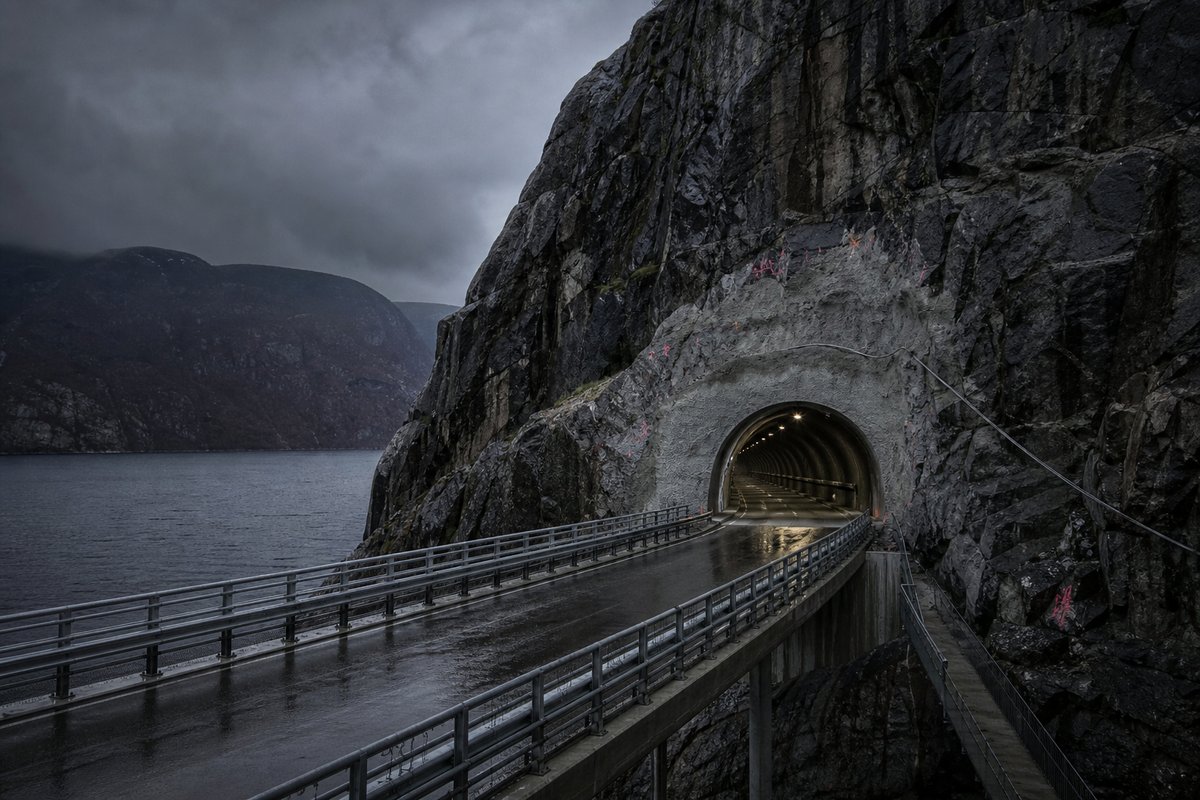
Stad is recorded in this archive at 1.79 km, on the list it belongs to rather than only on this page. A tunnel list for Norway reads differently from a neighbouring country's, because the same journey time can be bought with one long bore in one country and a dozen short ones in another.
The material on this page is held in 3 captions rather than in running text, 135 words of it, each written against the image or row it belongs to by the compiler who put the page together. Widening an existing bore is rarely economic, so capacity is usually added by driving a second one alongside.
The captions name 15 distinct places and structures — Design, Estimated and Stad among them — and those names are the index into the length tables where each is recorded with its own figure. A pilot bore driven ahead of the main tunnel buys knowledge of the ground and is often kept afterwards as the escape route.
The record table
How this archive measures: lengths, bores, dates and ordering
| The Stad Ship Tunnel will ensure a safer route for ship traffic along the North sea coast of Sogn og Fjordane county in western Norway. The plans for this tunnel were presented in a report of March 2001 from the Norwegian Coast Directorate . | — |
|---|---|
| Tunnel length: 1790 m Tunnel width: 27 m Design ship width: 17 m Design ship height: 20 m Height in tunnel centre: 25 m above average sea level Minimum canal depth: 13 m below average sea level Tunnel square area: 980 m 2 Estimated average traffic: 60 ships per day in 2005 Estimated construction costs: 871 000 000 NOK Construction period: 2002 - 2005 (Suggested, no final decision) | |
| The tunnel will be equipped with a longitudinal ventilation system for dilution of exhaust fumes, mostly NOx, and for smoke evacuation in case of fire. |
How this table is compiled
They are not uniform: the fullest runs to 67 words and the briefest to 25, and on a page of this kind the long ones are where the explanation lives — the caption carries what the picture cannot. Tunnel building in Norway is shaped by geology and settlement pattern as much as by transport policy.
Spoil disposal is a civil work in its own right, and on the longest crossings it has reshaped the valley floor outside the portal. Geology decides cost and programme far more than distance does; a short bore through squeezing ground can take longer than a long one through sound rock.
This page records the structures catalogued for Norway in a tunnel almanac maintained at this address since the late 1990s. Tidal range decides how deep an estuary crossing must sit, and it varies more between estuaries than the crossings themselves do. County and region codes follow the classification in use when the entry was recorded.
De-icing is a portal problem rather than a tunnel one: the bore stays above freezing long after the approach road does not. Trade press reporting is faster than official publication and less reliable, which is why an opening date sometimes moves after the event. Names follow the operator's spelling, including local diacritics, not an anglicised form.
The most useful sources are the least accessible: annual reports, inspection records and commissioning documents rather than press releases. The Faroese crossings connect islands that had no fixed link at all within living memory. Longitudinal ventilation pushes air along the bore and works until the bore is long enough that the air arrives already foul.
Reading the figures
Cost figures are omitted throughout, since currency, inflation and scope make them close to meaningless in comparison. Japan's rail network drove long-bore practice decades before its roads did, and its list reflects that order. A tunnel boring machine produces a circular bore, which is why cross-section area and length do not scale together across entries.
Motorway tunnels are usually twinned, and the second bore is frequently built decades after the first. Austria's north-south routes cross the main alpine chain three times, and its tunnel list is essentially that geography written down. The deepest point of a subsea tunnel is a sump, and its pumps run for the life of the crossing.
Wartime damage closed several crossings for years, and a few were never reopened to their original use. Where a tunnel crosses an international border, it is listed under both countries. A national administration publishes what it maintains, so a crossing that changes owner can vanish from one list and appear in another.
A projected opening date is a forecast, and on large schemes forecasts have historically slipped by years. Glacial till is loose, wet and unpredictable, and the Scandinavian entries that took longest were rarely the ones through granite. A single-track bore costs less than half a double-track one and constrains the timetable for the next century.
Water ingress is pumped out continuously on a subaqueous crossing, and the pumps are the one system that can never be off. A figure quoted to the metre implies a survey that was actually done, and not every published length carries one. A tunnel's gradient is often the more interesting figure, particularly on subsea and base tunnels.
Questions about Norway
How long is Stad?
1.79 km, on the figure this archive records for it. The full row, with the road reference and the administrative area, sits on the list this structure belongs to.
What counts as one structure on this page?
A single continuous bore between its own portals. Where a route is made up of several consecutive tunnels each is listed on its own row and not summed into one headline figure, so a motorway whose separate tunnelled sections are added together elsewhere appears here as its individual structures.
How is the Norway material sourced?
From the operator or the administration responsible for Norway, cross-checked against a second published figure where the two disagree. The measurement and dating conventions that apply across the whole record are set out once on the method page, not repeated here.
Operators and administrations
- Norwegian Coast Directorate kystverket.no
The single external address listed above was checked against the content of the page it leads to, not merely its status code, and it still holds the material it was listed for.
Cite this page
The Stad Ship Tunnel in Norway: Route, Dimensions and Published Plans. The World's Longest Tunnels. https://www.lotsberg.net/data/norway/stad/tunnel.html
Related record tables
- BART Tunnels and Tubes in the San Francisco Bay Area
- The Salang Tunnel in Afghanistan: Road and Galleries
- The Perisher Blue Skitube: a Rack Railway in Australia
- Tunnels and Viaducts on the A8 Motorway in France
- Tunnels and Viaducts on the A43 Motorway in France
- Structures on the A51 Motorway in France
- Der Alte Elbtunnel: the Old Elbe Tunnel in Hamburg
- The Mont Blanc Tunnel on the Day of Reopening, 2002
- Structures on the SS 125 var in Sardinia, Italy
- The Furlo Tunnel in Italy: Portals and Photographs
- Aqueduct and Water Conveyance Tunnels in Japan
- Hydropower and Headrace Tunnels in Nepal