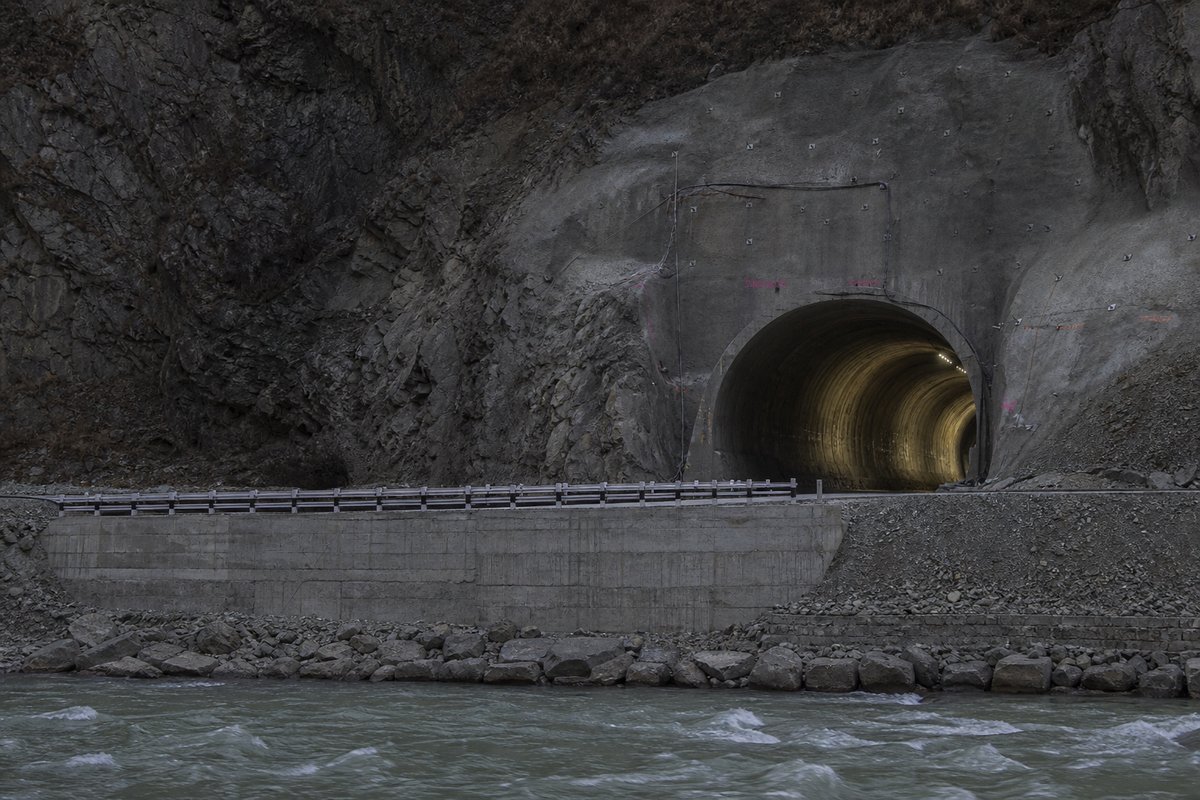
This page records the structures catalogued for Nepal in a tunnel almanac maintained at this address since the late 1990s. The headrace for khimti i column names 8 distinct entries on this page, Headrace of Marsyangdi and Intake tunnel of Kulekhani-I among them, each traceable to the operator or administration record it was taken from.
The table below lists 9 entries with a recorded length, each giving a name, a length in metres and, where documented, the year of opening. Lengths for Nepal are recorded in metres which is how the operators publish them and why the shortest entry here reads as 2 400 m and not a rounded figure.
Second and third place go to Headrace of Marsyangdi at 7.12 km and Intake tunnel of Kulekhani-I at 6.33 km. Laid end to end the entries on this page would run 44.18 km, which is a number with no engineering meaning but a useful sense of the scale of what is catalogued.
- 9entries listed
- 7.47 kmlongest bore
- 44.18 kmtotal length
The record table
How this archive measures: lengths, bores, dates and ordering
| Tunnel name (Name of Hydropower Project) | Length | Section | Diameter |
|---|---|---|---|
| Headrace for Khimti I | 7 466 m | 14 m 2 | |
| Headrace of Marsyangdi | 7 117 m | 6.4 m 2 | |
| Intake tunnel of Kulekhani-I | 6 327 m | 5.6 m 2 | |
| Headrace for Kali Gandaki | 5 925 m | 7.4 m | |
| Intake tunnel of Kulejhani-II | 5 848 m | 2.5 m | |
| Headrace for Chilime | 3 400 m | 2.6 m | |
| Headrace for Bhotekoshi | 3 300 m | 14 m 2 | |
| Headrace tunnel for Andhaikhola | 2 400 m | 7 m 2 | |
| Headrace for Tinau | 2 400 m |
How this table is compiled
Further down the table, Intake tunnel of Kulejhani-II is recorded at 5.85 km and Headrace for Chilime at 3.4 km. Only 4 of the 8 rows carry anything in the 14 m 2 column, so that field describes a minority of this table and the rest of the rows are recorded without it.
The median entry measures 5.85 km, so half the table sits below that and half above, which is a better guide to the typical structure here than the headline figure. The shortest recorded entry is 2.4 km against 7.47 km at the top, a spread of 3.11x across the same table.
The middle half of the table runs from 2.85 km to 6.72 km, and that band is where most of the engineering on this page actually sits. Between the longest and the tenth-longest the drop is 5.07 km, which is the part of the table that changes when a single scheme opens.
Where one of these 9 lengths disagrees with an operator's own figure for Nepal, the table keeps the published value and notes the difference instead of averaging the two. The longest entry is 3.1 times the shortest and 1.3 times the median, which is the quickest measure of how uneven the table is.
The entries sum to roughly 44.18 km of bore, an average of about 4.91 km each, though that average describes no actual row. The three longest entries alone account for 20.91 km of the 44.18 km on this page, which is 47 per cent of the total from 3 of 9 rows.
Reading the figures
A new scheme in Nepal would have to beat 7.47 km to change the head of this table, and that is the figure worth rechecking when one opens. The 9 rows for Nepal are ordered by length, not by date, so the most recent opening sits well down the table without being any less current.
4 of the 9 entries fall within a quarter of the median length, which is how tightly this particular list clusters around its typical structure. Eighth on the list is Headrace tunnel for Andhaikhola at 2.4 km, which is where the table stops being about record holders and starts being about ordinary infrastructure.
The table on this page runs to 8 rows and records Headrace for Khimti I, 7 466 m and 14 m 2 for each of them, which is the shape the original compiler chose rather than one imposed here. Tunnel building in Nepal is shaped by geology and settlement pattern as much as by transport policy.
The longest entry is Headrace for Khimti I, at 7.47 km. Read down the 7 466 m column, the 8 values run from 2 400 m to 7 117 m with a midpoint at 4 624 m; the spread rather than the maximum is what says how uneven this set is.
A tunnel list for Nepal reads differently from a neighbouring country's: 7 of these 9 structures pass three kilometres, and the same journey time is bought with one long bore in one country and a dozen short ones in another. Toll plazas sit outside portals rather than inside them, for ventilation reasons as much as for traffic ones.
Questions about Nepal
What is the longest structure in Nepal?
On the figures recorded here it is Headrace for Khimti I, at 7.47 km. It heads a table of 9 entries ordered by bore length, not by span, cost or construction difficulty.
How many structures are listed for Nepal?
9 entries with a recorded length appear on this page, from 2.4 km at the short end to 7.47 km at the top, with the middle of the set around 5.85 km.
What is a typical length among the structures listed for Nepal?
The median entry measures 5.85 km and the middle half of the table runs from 2.85 km to 6.72 km. The headline figure of 7.47 km is the outlier, not the norm, which is why the median is the more useful number when comparing one national list against another.
How close is the top of the Nepal table?
The longest stands 0.35 km clear of the next entry, and 2 entries sit within ten per cent of it. A newly announced scheme therefore has to beat 7.47 km to displace Headrace for Khimti I.
Cite this page
Hydropower and Headrace Tunnels in Nepal, with Lengths and Sections. The World's Longest Tunnels. https://www.lotsberg.net/data/nepal/hydropower.html
Related record tables
- BART Tunnels and Tubes in the San Francisco Bay Area
- The Salang Tunnel in Afghanistan: Road and Galleries
- The Perisher Blue Skitube: a Rack Railway in Australia
- Tunnels and Viaducts on the A8 Motorway in France
- Tunnels and Viaducts on the A43 Motorway in France
- Structures on the A51 Motorway in France
- Der Alte Elbtunnel: the Old Elbe Tunnel in Hamburg
- The Mont Blanc Tunnel on the Day of Reopening, 2002
- Structures on the SS 125 var in Sardinia, Italy
- The Furlo Tunnel in Italy: Portals and Photographs
- Aqueduct and Water Conveyance Tunnels in Japan
- The Laerdal Tunnel: the World's Longest Road Tunnel