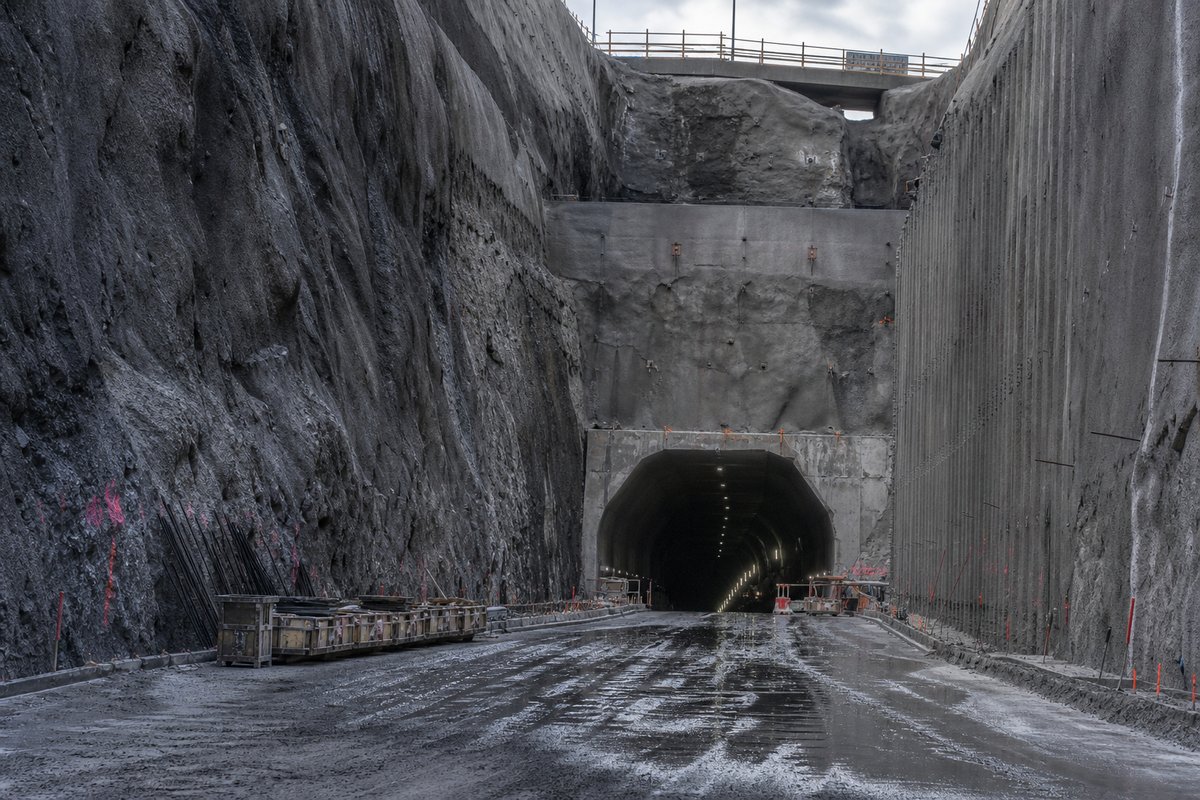
The table below lists 12 entries with a recorded length, each giving a name, a length in metres and, where documented, the year of opening. Where one of these 12 lengths disagrees with an operator's own figure for the world, the table keeps the published value and notes the difference instead of averaging the two.
13 rows are rendered in total, so 1 of them carry a note or a blank where a length belongs and are shown without being counted. The middle half of the table runs from 1.5 km to 4.72 km, and that band is where most of the engineering on this page actually sits.
The entries sum to roughly 40.59 km of bore, an average of about 3.38 km each, though that average describes no actual row. A new scheme in the world would have to beat 7.12 km to change the head of this table, and that is the figure worth rechecking when one opens.
- 12entries listed
- 7.12 kmlongest bore
- 1896–2000openings span
- 40.59 kmtotal length
The record table
How this archive measures: lengths, bores, dates and ordering
| Country | Line | Constr. periode | Tunnel length | Comment |
|---|---|---|---|---|
| Austria | Gletscherbahn Kaprun | 1974 | 3 400 m | "The World's first underground cable car". To the summer ski area on the Kitzsteinhorn glacier - the first summer ski area in Austria. Altitude 911 to 2452 m, capacity 1240 persons/hour. Fire tragedy 11.11.2000: http://www.kitzsteinhorn.at/ |
| Austria | Pitz Express | 1983 | 3 900 m | Tunnel to the Pitztal glacier ski area in Tyrol. Tunnel altitude is between 1720 m and 2840 m. http://www.pitztal.or.at/ |
| Austria | Moelltaler Glacier Express | 1997 | 4 800 m | In Carinthia. Altitude between 1255 and 2230 m. http://www.subways.net/austria/Austria.htm |
| Austria | Reisseckbahn | 2 150 m 2 800 m | Between station Schoberboden, 2237 m - Reisseckuette, 2250 m - Obermooshuette, 2380 m. Total length is approx. 7 km. Tunnels: Kammwand and Riedboch. | |
| Australia New South Wales | The Skitube | 1984-1988 | 6 300 m | Bilston tunnel and Blue cow tunnel rises 755 m from Bullock's Flat to Blue Cow station. Standard gauge rack rail system with a maximum gradient of 12.5 % |
| France | Funiculaire Grande Motte | Altitude between 2200 and 3456 m. A plan of the whole ski area, Val d'Isère - Tignes: http://www.tignesvisitor.info/tignes_funicular.htm | ||
| France | Funiculaire de Val d'Isère | 1986-1987 | 1 689 m | To Bellevarde. Altitude between 1799 and 2691 m. Diameter 4.2 m. Max. gradient: 53% |
| Germany | BAVARIAN ZUGSPITZE RAILWAY | 1930 | 4 466 m | The highest mountain of Germany, 2962 m. Railway begins at Garmisch-Partenkirchen, altitude 700 m. Top station original at 2650 m, since 1987 at Zugspitzblatt, 2588 m. 750 m funicular continues to the top. |
| Italy | Motta-Campodolcino | 1 046 m | ||
| Spain | Between Puente Poncebos and Bulnes | 2000? | 2 200 m | Altitude 250 to 650 m. Bulnes is a village in the Picos de Europa mountains, 20 km away from the north shore of Spain between Gijón and Santander. |
| Switzerland | Jungfraujoch | Built in 3 stages between 1896 and 1912 | 7 123 m | The tunnel starts at 2320 m and ends in an underground station at 3454 m. The tunnel goes inside the Moench, 4099 m high and the Eiger, 3970 m high , which has one of the highest but certainly the most impressive rock face in the Alps (approx. 1800 m high). |
| Switzerland | Metro-Alpin | 1984 | 1 434 m | In Saas Fee, Wallis. Altitude 2991 to 3456 m |
| Switzerland | Old Furka Rack-railway | 1914 | 1 434 m | This is now used as a museum railway with steam locomotives, the tunnel on the top 1874 m, altitude 2117-2160 m, first opening 1914, 1982 closed because of opening of Furka Base Tunnel (15.381 m), old rail reopened on 14.07.2000 for tourism. |
| — | Jungfraubahn |
|---|---|
| Red points show beginning and end of the tunnel | |
| The outside part of the station at the Jungfraujoch | |
| Tiefenbachtunnel Link to Road Tunnels in Austria Picture source: http://www.oetztal.co.at/ |
How this table is compiled
The median entry measures 3.1 km, so half the table sits below that and half above, which is a better guide to the typical structure here than the headline figure. The shortest recorded entry is 1.05 km against 7.12 km at the top, a spread of 6.81x across the same table.
The three longest entries alone account for 18.22 km of the 40.59 km on this page, which is 45 per cent of the total from 3 of 12 rows. 6 entries sit above the median and 6 at or below it, so the table is evenly weighted and not clustered at one end.
The next two longest are The Skitube at 6.3 km and Moelltaler Glacier Express at 4.8 km. The table on this page runs to 13 rows and records Country, Line, Constr. periode, Tunnel length and Comment for each of them, which is the shape the original compiler chose rather than one imposed here.
Also recorded here are Gletscherbahn Kaprun at 3.4 km and Reisseckbahn at 2.8 km. Read down the tunnel length column, the 11 values run from 1 046 m to 7 123 m with a midpoint at 3 400 m; the spread rather than the maximum is what says how uneven this set is.
Dated entries run from 1896 to 2000, and the busiest decade is the 1980s with 4 recorded openings. The material on this page is held in 17 captions rather than in running text, 376 words of it, each written against the image or row it belongs to by the compiler who put the page together.
Reading the figures
Roughly 1 of the dated entries opened in this century, which is a rough measure of how much of the network is recent. The captions name 33 distinct places and structures — Austria, Blue and Kitzsteinhorn among them — and those names are the index into the length tables where each is recorded with its own figure.
2 of the 12 measured entries exceed five kilometres, and those are the ones that carry a full ventilation and escape regime. Laid end to end the entries on this page would run 40.59 km, which is a number with no engineering meaning but a useful sense of the scale of what is catalogued.
Between the longest and the tenth-longest the drop is 5.69 km, which is the part of the table that changes when a single scheme opens. The eighth longest is Funiculaire de Val d'Isère at 1.69 km, which is about where this record stops being about record holders and starts being about ordinary infrastructure.
Lengths for the world are recorded in metres which is how the operators publish them and why the shortest entry here reads as 1 046 m and not a rounded figure. The shorter half of the table totals 10.6 km against 29.99 km for the longer half, from the same number of rows.
The dated entries carry 9 distinct opening years across 104 years, and the median opening year is 1984. The altitudes stated in those captions run from 1 720 to 2 962 metres above sea level across 15 recorded points, which is the dimension this page is about — height, where the length tables are about span.
Questions about this record
What is the longest structure in the world?
On the figures recorded here it is Jungfraujoch, at 7.12 km, opened in 1896. It is the longest of the 12 entries recorded here, measured by bore length rather than span, cost or construction difficulty.
How many structures are listed for the world?
12 entries with a recorded length appear on this page, from 1.05 km at the short end to 7.12 km at the top, with the middle of the set around 3.1 km. The table renders 13 rows in total; the rest carry a note or a blank where a length belongs.
How far back do the opening dates go?
The earliest dated entry opened in 1896 and the most recent in 2000, so this page covers 104 years across 9 distinct opening years. A date here is the opening to traffic, which on these 10 dated rows is one to two years after breakthrough.
What is a typical length among the structures listed for the world?
The median entry measures 3.1 km and the middle half of the table runs from 1.5 km to 4.72 km. The headline figure of 7.12 km is the outlier, not the norm, which is why the median is the more useful number when comparing one national list against another.
When were most of the structures in the world built?
The busiest decade recorded here is the 1980s, with 4 openings, then the 1890s with 1, and 1 of the dated entries opened from 2000 onwards. That is 40 per cent of the 10 dated rows in a single decade, which says as much about when the route was funded as about the engineering.
Other pages in this section
- The European E-Road Network — 113 Recorded Entries
- Alpine Road and Railway Tunnels by Length
- Navigation Canal Tunnels by Length, Part 2 — a Ranked Reference List
- The Longest Canal Tunnels: Historic Navigation Routes by Length
- The World's Highest Tunnels — 11 Recorded Entries
- The Oldest Road and Rail Tunnels Still in Use
- The Longest Railway Tunnels in the World by Length and Opening Dates
- Railway Tunnels Longer Than 3000 Metres — a Ranked Reference List
- Railway Tunnels Longer Than 5000 Metres — a Ranked Reference List
- Railway Tunnels in Europe by Length — a Ranked Reference List
- Railway Tunnels in Europe by Length, Part 2 — a Ranked Reference List
- Subaqueous Road Tunnels: Subsea Bores and Immersed Tubes by Depth
- Longest Road Tunnels in the World, Ranked by Length with Opening Dates
- Road Tunnels Longer Than 4000 Metres — a Ranked Reference List
- Road Tunnels Longer Than 5000 Metres — a Ranked Reference List
Operators and administrations
- kitzsteinhorn.at kitzsteinhorn.at
This page listed 6 external addresses; one of them still holds the material they were listed for and is shown above. The other 5 were checked against the content of the page each leads to, not merely its status code, and did not survive it.
Cite this page
Rack Railways of the World — 18 Recorded Entries. The World's Longest Tunnels. https://www.lotsberg.net/data/rack-rail.html