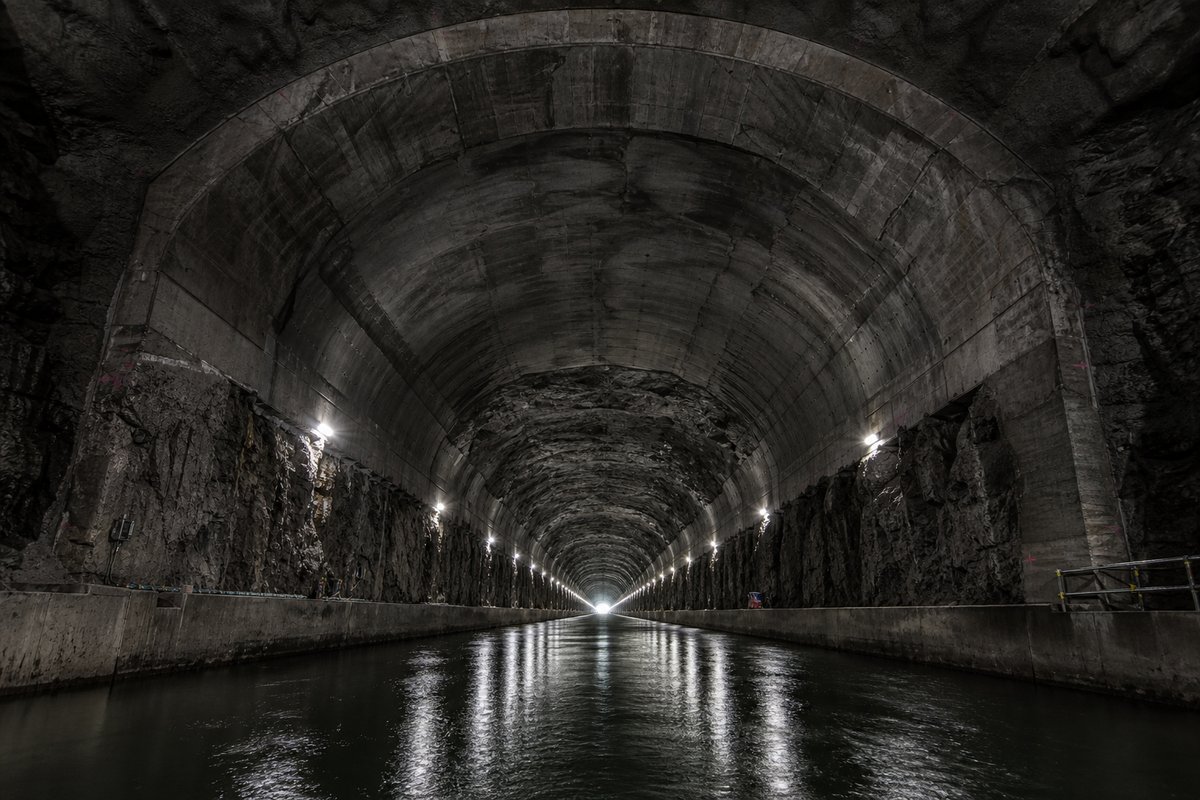
The table below lists 28 entries with a recorded length, each giving a name, a length in metres and, where documented, the year of opening. Where one of these 28 lengths disagrees with an operator's own figure for the world, the table keeps the published value and notes the difference instead of averaging the two.
29 rows are rendered in total, so 1 of them carry a note or a blank where a length belongs and are shown without being counted. The middle half of the table runs from 0.14 km to 0.5 km, and that band is where most of the engineering on this page actually sits.
The entries sum to roughly 8.84 km of bore, an average of about 0.32 km each, though that average describes no actual row. Lengths for the world are recorded in metres which is how the operators publish them and why the shortest entry here reads as 52 m and not a rounded figure.
- 28entries listed
- 0.88 kmlongest bore
- 1815–1819openings span
- 8.84 kmtotal length
The record table
How this archive measures: lengths, bores, dates and ordering
| Country | Tunnel | Length | Canal | Year of construction | Comment |
|---|---|---|---|---|---|
| England | Islington | 878 m | Regent's | 1819 | London |
| Saddington | 805 m | Grand Union | |||
| Shortwood | 560 m | Worcester & Birmingham | 1791 - 1815 | Construction periode for the canal | |
| Tardebigge | 530 m | Worcester & Birmingham | 1791 - 1815 | Construction periode for the canal | |
| Barnton | 523 m | Trent & Mersey | The Grand Trunk | ||
| Gannow | 511 m | Leeds & Liverpool | |||
| Gosty Hill | 509 m | Dudley No. 2 | 1798 | ||
| Severnake or Bruce | 459 m | Kennet & Avon | |||
| Chirk | 419 m | Llangollen | |||
| Shrewley | 396 m | Grand Union | |||
| Saltersford | 388 m | Trent & Mersey | The Grand Trunk | ||
| Coseley | 329 m | BCN Main Line | |||
| Brandwood | 322 m | Stratford upon Avon | |||
| Maida Hill | 249 m | Regent's | London | ||
| Newbold | 228 m | Oxford | |||
| Snareston | 228 m | Ashby | |||
| Dunhampstead | 216 m | Worcester & Birmingham | 1791 - 1815 | Construction periode for the canal | |
| Scout | 201 m | Huddersfield Narrow | |||
| Ellesmere | 174 m | Llangollen | |||
| Hyde Bank | 152 m | Peak Forest | |||
| Woodley | 152 m | Peak Forest | (Hyde Bank?) | ||
| Drakeholes | 140 m | Chesterfield | |||
| Leek | 119 m | Trent & Mersey | The Grand Trunk | ||
| Edgebaston | 96 m | Worcester & Birmingham | 1791 - 1815 | Construction periode for the canal | |
| Cowley | 74 m | Shropshire Union | |||
| Froghall | 69 m | Trent & Mersey | Caldon Branch | ||
| Cookley | 59 m | Staffordshire & Worcestershire | |||
| Curdworth | 52 m | Birmingham & Fazeley | |||
| Eyre's | 48 m | Regent's | London |
How this table is compiled
This page records the canal tunnels catalogued for the world in a tunnel almanac maintained at this address since the late 1990s. Laid end to end the entries on this page would run 8.84 km, which is a number with no engineering meaning but a useful sense of the scale of what is catalogued.
The median entry measures 0.24 km, so half the table sits below that and half above, which is a better guide to the typical structure here than the headline figure. The shortest recorded entry is 0.05 km against 0.88 km at the top, a spread of 16.88x across the same table.
The three longest entries alone account for 2.24 km of the 8.84 km on this page, which is 25 per cent of the total from 3 of 28 rows. 14 entries sit above the median and 14 at or below it, so the table is evenly weighted and not clustered at one end.
A new scheme in the world would have to beat 0.88 km to change the head of this table, and that is the figure worth rechecking when one opens. 5 of the 28 entries fall within a quarter of the median length, which is how tightly this particular list clusters around its typical structure.
The 28 rows for the world are ordered by length, not by date, so the 1819 opening sits well down the table without being any less current. Eighth on the list is Severnake or Bruce at 0.46 km, which is where the table stops being about record holders and starts being about ordinary infrastructure.
Reading the figures
The ten longest average 0.56 km against 0.18 km for everything below them, and that ratio is the clearest thing this table says about the distribution. The tunnel column names 29 distinct entries on this page, Islington and Saddington among them, each traceable to the operator or administration record it was taken from.
Read down the length column, the 29 values run from 48 m to 878 m with a midpoint at 228 m; the spread rather than the maximum is what says how uneven this set is. Rack railways climb where adhesion alone cannot, and their tunnels are short, steep and unlike anything on a main line.
Dated entries run from 1815 to 1819, and the busiest decade is the 1810s with 5 recorded openings. The table on this page runs to 29 rows and records Country, Tunnel, Length, Canal and Year of construction for each of them, which is the shape the original compiler chose rather than one imposed here.
Roughly 0 of the dated entries opened in this century, which is a rough measure of how much of the network is recent. Only 6 of the 29 rows carry anything in the year of construction column, so that field describes a minority of this table and the rest of the rows are recorded without it.
Between the longest and the tenth-longest the drop is 0.48 km, which is the part of the table that changes when a single scheme opens. The longest entry is 16.9 times the shortest and 3.7 times the median, which is the quickest measure of how uneven the table is.
Questions about World record table
What is the longest canal tunnel in the world?
On the figures recorded here it is Islington, at 0.88 km, opened in 1819. It heads a table of 28 entries ordered by bore length, not by span, cost or construction difficulty.
How many canal tunnels are listed for the world?
28 entries with a recorded length appear on this page, from 0.05 km at the short end to 0.88 km at the top, with the middle of the set around 0.24 km. The table renders 29 rows in total; the rest carry a note or a blank where a length belongs.
How far back do the opening dates go?
The earliest dated entry opened in 1815 and the most recent in 1819, so this page covers 4 years. A date here is the opening to traffic, which on these 5 dated rows is one to two years after breakthrough.
What is a typical length among the canal tunnels listed for the world?
The median entry measures 0.24 km and the middle half of the table runs from 0.14 km to 0.5 km. The headline figure of 0.88 km is the outlier, not the norm, which is why the median is the more useful number when comparing one national list against another.
When were most of the canal tunnels in the world built?
The busiest decade recorded here is the 1810s, with 5 openings, and 0 of the dated entries opened from 2000 onwards. That is 100 per cent of the 5 dated rows in a single decade, which says as much about when the route was funded as about the engineering.
Other pages in this section
- The European E-Road Network — 113 Recorded Entries
- Alpine Road and Railway Tunnels by Length
- The Longest Canal Tunnels: Historic Navigation Routes by Length
- The World's Highest Tunnels — 11 Recorded Entries
- The Oldest Road and Rail Tunnels Still in Use
- Rack Railways of the World — 18 Recorded Entries
- The Longest Railway Tunnels in the World by Length and Opening Dates
- Railway Tunnels Longer Than 3000 Metres — a Ranked Reference List
- Railway Tunnels Longer Than 5000 Metres — a Ranked Reference List
- Railway Tunnels in Europe by Length — a Ranked Reference List
- Railway Tunnels in Europe by Length, Part 2 — a Ranked Reference List
- Subaqueous Road Tunnels: Subsea Bores and Immersed Tubes by Depth
- Longest Road Tunnels in the World, Ranked by Length with Opening Dates
- Road Tunnels Longer Than 4000 Metres — a Ranked Reference List
- Road Tunnels Longer Than 5000 Metres — a Ranked Reference List
Operators and administrations
- Islington canalmuseum.org.uk
This page listed 7 external addresses; one of them still holds the material they were listed for and is shown above. The other 6 were checked against the content of the page each leads to, not merely its status code, and did not survive it.
Cite this page
Navigation Canal Tunnels by Length, Part 2 — a Ranked Reference List. The World's Longest Tunnels. https://www.lotsberg.net/data/canal-2.html