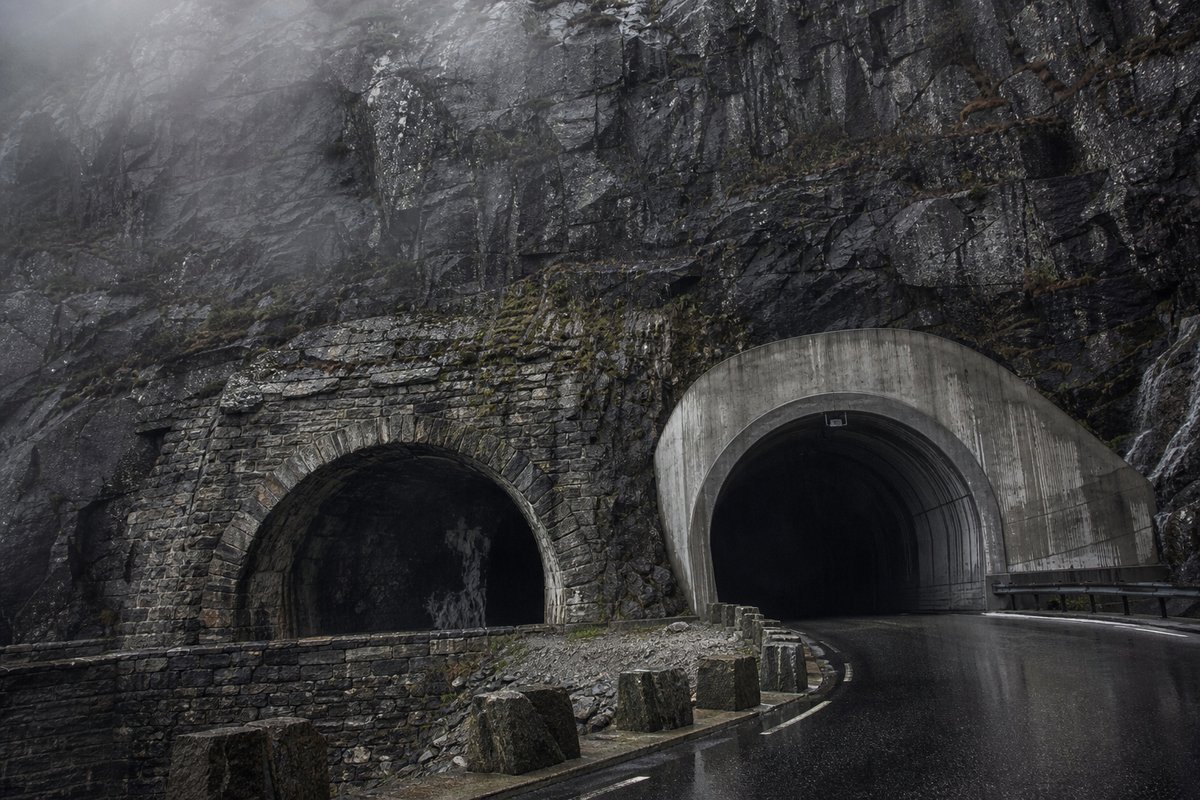
Eiksund opened in 2008 and Qing-Huang 3 years later in 2011, and that gap usually matters more than the length difference. The median subaqueous tunnel in this archive measures 3.4 km, so both entries here are well clear of the ordinary case and the comparison is between two outliers rather than two typical crossings.
Qing-Huang is the longer of the two at 7.8 km, ahead of Eiksund at 7.8 km, a difference of 0 km. Qing-Huang is 1.00 times the length of Eiksund, and it is the ratio rather than the 0 km that says how differently the two crossings had to be ventilated and escaped.
A 3-year gap spans real changes in ventilation, escape provision and excavation method, so the two were not built to the same standard. This archive separates 4 classes of structure and both entries here are indexed under subaqueous tunnel, which decides the table each is ranked in and the convention its length was measured by.
- 5entries listed
Side by side
Qing-Huang is recorded on data/subsea.html and Eiksund on data/subsea.html, compiled to the same convention, which is what makes the two figures comparable at all.
How this archive measures: lengths, bores, dates and ordering
| Measure | Qing-Huang | Eiksund |
|---|---|---|
| Length | 7.8 km | 7.8 km |
| Length in metres | 7 800 m | 7 797 m |
| Opened | 2011 | 2008 |
| Class | subaqueous tunnel | subaqueous tunnel |
| Difference | 0 km longer | — |
How this table is compiled
Qing-Huang and Eiksund are compared here on the figures this archive records for each, taken from the same sources and the same measurement convention. Qing-Huang belongs to the 2010s and Eiksund to the 2000s, two decades in which what a tunnel had to provide by way of escape and ventilation was not the same thing.
That gap is about 0 per cent of the longer bore, which is the figure worth holding on to rather than the raw metres. Driven end to end the two would run 15.6 km, which is the figure to hold against the 10.8 km of the longest single subaqueous tunnel in the record.
Both rows are reachable from the subaqueous tunnel table they were taken from, where the note column carries the tube count, the gradient and any reconstruction Qing-Huang or Eiksund has had. Across every class this archive records, Qing-Huang stands 165th by length and Eiksund 166th, so the pair sits inside the top 166 of 244 structures.
58 other structures in this record opened within two years of Qing-Huang, which is the cohort it was designed alongside and the fairer comparison for how it was built. The 2000s account for 53 entries in this archive, and Eiksund is one of them, which is the context a single opening date does not carry on its own.
Neither holds the record: Sandoy at 10.8 km is the longest subaqueous tunnel recorded here, 3 km ahead of Qing-Huang. A disused rail bore is the commonest cycleway in some countries, which is a second life a length ranking cannot show. Smoke moves uphill, so the two portals of a burning tunnel are not equally dangerous.
Reading the figures
Both are recorded in this archive as subaqueous tunnels, so the measurement convention is identical and the comparison is direct. 164 recorded structures are longer than Qing-Huang, the nearest of them Bømlafjord at 7.93 km. The interesting figure on most crossings is the gradient or the cover, and neither appears in a ranking by length.
Adding a metre to the longest tunnel in the world costs what adding a kilometre to an ordinary one does. Nothing in either row is estimated: a value that could not be corroborated is left blank rather than filled in. A short bore beneath a city can cost more than a long one through a mountain.
Qing-Huang was designed under the modern regime, with cross-passage spacing and emergency ventilation specified from the outset. Among the subaqueous tunnels this archive records, Qing-Huang stands 5th by length and Eiksund 6th, adjacent in the ranking. Fixed links change settlement patterns, so the traffic a crossing carries later is not the traffic that justified it.
Environmental consent now outlasts construction on many schemes, and the dates in a record rarely show it. Wartime damage closed several crossings for years and a few were never reopened to their original use. Comparing two national records says as much about how each country documents its infrastructure as about the infrastructure.
Depth below sea level is recorded where published. Length is measured portal to portal. Nothing on this page requires scripting to read. Sources are named on each structure's own table. A pilot bore driven ahead of the main tunnel is usually kept afterwards as the escape route. The longer bore is not the harder job.
Questions about this record
Which is longer, Qing-Huang or Eiksund?
Qing-Huang, at 7.8 km against 7.8 km — a difference of 0 km, or 0 per cent of the longer bore. Both are portal-to-portal figures as published by the operator or the responsible administration.
Was Qing-Huang harder to build than Eiksund?
Not necessarily, and its 0 km of extra length is the weakest evidence available. Geology, water and the number of headings decide difficulty; Eiksund at 7.8 km may well have been the harder job, and nothing in a length column would show it.
Which of the two opened first?
Eiksund, in 2008, 3 years before Qing-Huang in 2011. Both dates are the admission of traffic, so Eiksund was already carrying it while Qing-Huang was still being driven.
Are the two figures measured the same way?
Yes. Both are recorded in this archive as subaqueous tunnels, portal to portal along the carriageway or track centre line, in metres, as published by the operator or the responsible administration.
Other pages in this section
- Arlberg vs Daliangshan No: length, opening date and class compared
- Bømlafjord vs Qing-Huang: length, opening date and class compared
- Changxing vs Bømlafjord: length, opening date and class compared
- Chunnel vs Yulhyeon: length, opening date and class compared
- Daliangshan No vs Muzhailing: length, opening date and class compared
- Eiksund vs Karmøy: length, opening date and class compared
- Gotthard Base vs Sei-kan: length, opening date and class compared
- Tunnel comparisons: length, depth and opening date, side by side
- Jinpingshan vs St. Gotthard / San Gottardo: length and opening date
- Karmøy vs Oslofjord: length, opening date and class compared
- Koralm vs New Guanjiao: length, opening date and class compared
- Laerdal vs Gotthard Base: length, opening date and class compared
- Laerdal vs Ryfylke: length, opening date and class compared
- Lötschberg vs Koralm: length, opening date and class compared
- Mont-Blanc / Monte Bianco vs Fréjus: length, opening date, class
- Muzhailing vs Zigana: length, opening date and class compared
- New Guanjiao vs Guadarrama: length, opening date and class compared
- Ryfylke vs Eiksund: length, opening date and class compared
- Sandoy vs Tokyo Aqua: length, opening date and class compared
- Sei-kan vs Chunnel: length, opening date and class compared
- Shanghai Airport Link vs Songshan Lake: length and opening date
- Shenzhen vs Lötschberg: length, opening date and class compared
- Simplon-I vs Fréjus: length, opening date and class compared
- Songshan Lake vs Shenzhen: length, opening date and class compared
- St. Gotthard / San Gottardo vs Laerdal: length, opening date, class
- St. Gotthard / San Gottardo vs Tiantaishan: length and opening date
- Tianshan Shengli vs Laerdal: length, opening date and class compared
- Tianshan Shengli vs Yamate: length, opening date and class compared
- Tiantaishan vs Arlberg: length, opening date and class compared
- Tokyo Aqua vs Changxing: length, opening date and class compared
- Yamate vs Zhongnanshan: length, opening date and class compared
- Yulhyeon vs Shanghai Airport Link: length, opening date and class
- Zhongnanshan vs Jinpingshan: length, opening date and class compared
- Zhongnanshan vs Laerdal: length, opening date and class compared
Cite this page
Qing-Huang vs Eiksund: length, opening date and class compared. The World's Longest Tunnels. https://www.lotsberg.net/compare/qing-huang-vs-eiksund.html
Related record tables
- Tunnel comparisons: length, depth and opening date
- Laerdal vs Gotthard Base: length and opening date
- Laerdal vs Ryfylke: length and opening date
- St. Gotthard / San Gottardo vs Laerdal: length and opening year
- Mont-Blanc / Monte Bianco vs Fréjus: length and opening date
- Zhongnanshan vs Laerdal: length and opening date
- Tianshan Shengli vs Laerdal: length and opening date
- Yamate vs Zhongnanshan: length and opening date
- Ryfylke vs Eiksund: length and opening date
- Simplon-I vs Fréjus: length and opening date
- Tianshan Shengli vs Yamate: length and opening date
- Zhongnanshan vs Jinpingshan: length and opening date