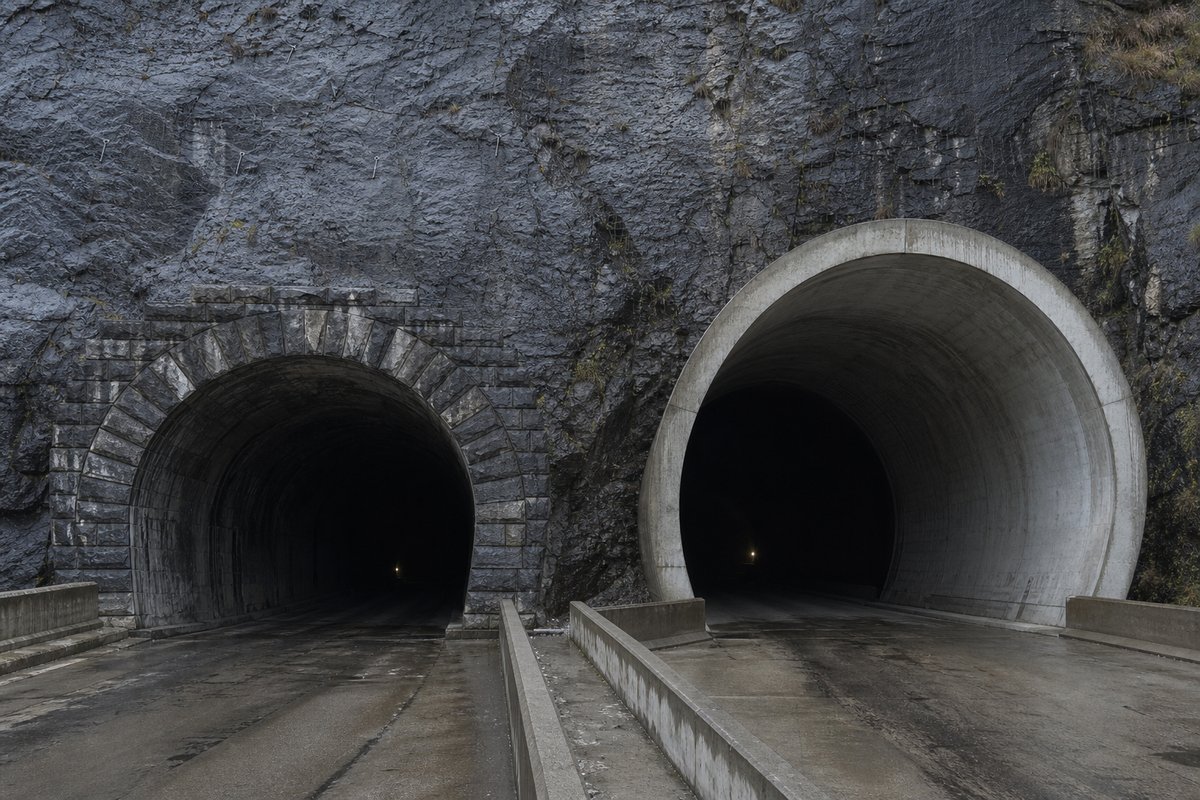
The pairs are the matchups readers actually look for, plus each class's adjacent record holders, which are the comparisons where the margin is smallest. Comparing two tunnels on length alone is the question most readers ask and the least informative answer available, which is why the differences that matter are set out below.
Blank cells mean the value is not on record. Where a structure has been lengthened by a later extension the current figure is the one recorded, with the original noted alongside it. Spoil from a long bore is a civil work of its own, and outside several alpine portals it has become a permanent landform.
Portal design follows avalanche and rockfall exposure rather than architectural intent. An intermediate shaft turns one heading into two and leaves a structure on the surface for the life of the tunnel. Geology decides cost and programme far more than distance does, so a shorter bore through difficult ground can be the greater achievement.
- 34entries listed
Every comparison
Each comparison is its own page with a permanent address, so a specific matchup can be linked to directly. Only structures open to traffic are compared.
How this archive measures: lengths, bores, dates and ordering
| Comparison | Class | Lengths | Page |
|---|---|---|---|
| Laerdal vs Gotthard Base | road tunnel | 24.51 km vs 57.1 km | Open |
| Laerdal vs Ryfylke | road tunnel | 24.51 km vs 14.46 km | Open |
| St. Gotthard / San Gottardo vs Laerdal | road tunnel | 16.94 km vs 24.51 km | Open |
| Mont-Blanc / Monte Bianco vs Fréjus | road tunnel | 11.61 km vs 12.9 km | Open |
| Zhongnanshan vs Laerdal | road tunnel | 18.04 km vs 24.51 km | Open |
| Tianshan Shengli vs Laerdal | road tunnel | 22.13 km vs 24.51 km | Open |
| Yamate vs Zhongnanshan | road tunnel | 18.2 km vs 18.04 km | Open |
| Ryfylke vs Eiksund | road tunnel | 14.46 km vs 7.8 km | Open |
| Simplon-I vs Fréjus | railway tunnel | 19.8 km vs 12.9 km | Open |
| Tianshan Shengli vs Yamate | road tunnel | 22.13 km vs 18.2 km | Open |
| Zhongnanshan vs Jinpingshan | road tunnel | 18.04 km vs 17.5 km | Open |
| Jinpingshan vs St. Gotthard / San Gottardo | road tunnel | 17.5 km vs 16.94 km | Open |
| St. Gotthard / San Gottardo vs Tiantaishan | road tunnel | 16.94 km vs 15.56 km | Open |
| Tiantaishan vs Arlberg | road tunnel | 15.56 km vs 15.52 km | Open |
| Arlberg vs Daliangshan No | road tunnel | 15.52 km vs 15.37 km | Open |
| Daliangshan No vs Muzhailing | road tunnel | 15.37 km vs 15.23 km | Open |
| Muzhailing vs Zigana | road tunnel | 15.23 km vs 14.48 km | Open |
| Gotthard Base vs Sei-kan | railway tunnel | 57.1 km vs 53.85 km | Open |
| Sei-kan vs Chunnel | railway tunnel | 53.85 km vs 50.45 km | Open |
| Chunnel vs Yulhyeon | railway tunnel | 50.45 km vs 50.3 km | Open |
| Yulhyeon vs Shanghai Airport Link | railway tunnel | 50.3 km vs 40.19 km | Open |
| Shanghai Airport Link vs Songshan Lake | railway tunnel | 40.19 km vs 38.81 km | Open |
| Songshan Lake vs Shenzhen | railway tunnel | 38.81 km vs 35.66 km | Open |
| Shenzhen vs Lötschberg | railway tunnel | 35.66 km vs 34.58 km | Open |
| Lötschberg vs Koralm | railway tunnel | 34.58 km vs 32.9 km | Open |
| Koralm vs New Guanjiao | railway tunnel | 32.9 km vs 32.65 km | Open |
| New Guanjiao vs Guadarrama | railway tunnel | 32.65 km vs 28.42 km | Open |
| Sandoy vs Tokyo Aqua | subaqueous tunnel | 10.8 km vs 9.58 km | Open |
| Tokyo Aqua vs Changxing | subaqueous tunnel | 9.58 km vs 8.95 km | Open |
| Changxing vs Bømlafjord | subaqueous tunnel | 8.95 km vs 7.93 km | Open |
| Bømlafjord vs Qing-Huang | subaqueous tunnel | 7.93 km vs 7.8 km | Open |
| Qing-Huang vs Eiksund | subaqueous tunnel | 7.8 km vs 7.8 km | Open |
| Eiksund vs Karmøy | subaqueous tunnel | 7.8 km vs 7.74 km | Open |
| Karmøy vs Oslofjord | subaqueous tunnel | 7.74 km vs 7.39 km | Open |
How this table is compiled
This index lists 34 head-to-head comparisons, each on its own page with a permanent address. Transverse ventilation gives each section its own supply and extract, which is why the long two-lane crossings carry a false ceiling. Cost figures are excluded throughout this archive, because currency, inflation and differing project scope make them close to meaningless in comparison.
A boring machine has to be assembled underground and is economic only past a length that varies with the rock. Length stands in for terrain more than for difficulty, and on a head-to-head the two crossings rarely faced the same terrain. Ventilation arrangement caps how long a bore can be driven more directly than money does.
A tunnel's gradient is often the more interesting figure, particularly on subsea crossings where vehicles have to climb back out. The interesting figure on most crossings is the gradient or the cover, and neither appears in a ranking by length. Rock cover above the bore governs a subsea design, not the depth of water above that.
A tunnel outlives the traffic forecast that paid for it, and most of its lifetime cost is ventilation and lighting. Base tunnels replaced summit lines that climbed by spiral and switchback, and several of those older routes survive above them. The first long bores were driven by hand and gunpowder, and their alignments still show it.
Overburden at the deepest point sets the lining, and on a long crossing it varies more than the length suggests. Published lengths for the same structure differ by a few metres between sources, depending on whether cut-and-cover approaches are counted. The tail of a record is more representative of what gets built than its head is.
Reading the figures
Opening dates refer to the admission of traffic, not to breakthrough, which normally falls a year or two earlier. Two-way traffic in one bore is what modern regulation avoids and what most older road crossings were built with. Environmental consent now outlasts construction on many schemes, and the dates in a record rarely show it.
Wartime damage closed several crossings for years and a few were never reopened to their original use. This archive has held per-country and per-class tunnel inventories since the late 1990s, compiled from operator and administration sources. Lighting is brightest at a portal in daylight, because the adapting eye is the hazard rather than the dark.
Catenary needs headroom a road tunnel does not, so an electrified bore is taller for the same traffic. The oldest crossings still carrying traffic were built before any of the codes that now govern their upkeep. Traffic volumes are excluded for the same reason, and because they date far faster than the structures themselves.
Reconstruction after a fire is recorded because it usually changes both the profile and the ventilation arrangement. A comparison of two crossings is a comparison of two ground conditions, and the length column records neither. A short bore beneath a city can cost more than a long one through a mountain.
Height above sea level is a separate record from length. Both figures come from the same archive and the same convention. Sequential excavation is slower per metre and far more tolerant of ground that changes without warning. Cross-passage spacing, fixed firefighting and emergency ventilation control are what modern tunnel safety regulation actually governs.
Questions about this record
Why is each comparison a separate page?
So that a specific matchup has a permanent address that can be linked to, cited and found directly. Nothing here needs scripting: every comparison is a static page.
Which structures can be compared?
Any two in the same class that are open to traffic. Comparing across classes is possible but rarely meaningful, because a road bore, a rail bore and a canal tunnel are built to different constraints.
Where do the lengths on these pages come from?
From the record tables in this archive, which are compiled from operator publications, national road and rail administrations and the engineering press. Both sides of every comparison use the same measurement convention, which is what makes the difference meaningful.
Are structures still under construction included?
No. A comparison only lists structures open to traffic, because a projected length and a measured one are not the same kind of figure and a bore that has not opened cannot hold a record.
Other pages in this section
- Arlberg vs Daliangshan No: length, opening date and class compared
- Bømlafjord vs Qing-Huang: length, opening date and class compared
- Changxing vs Bømlafjord: length, opening date and class compared
- Chunnel vs Yulhyeon: length, opening date and class compared
- Daliangshan No vs Muzhailing: length, opening date and class compared
- Eiksund vs Karmøy: length, opening date and class compared
- Gotthard Base vs Sei-kan: length, opening date and class compared
- Jinpingshan vs St. Gotthard / San Gottardo: length and opening date
- Karmøy vs Oslofjord: length, opening date and class compared
- Koralm vs New Guanjiao: length, opening date and class compared
- Laerdal vs Gotthard Base: length, opening date and class compared
- Laerdal vs Ryfylke: length, opening date and class compared
- Lötschberg vs Koralm: length, opening date and class compared
- Mont-Blanc / Monte Bianco vs Fréjus: length, opening date, class
- Muzhailing vs Zigana: length, opening date and class compared
- New Guanjiao vs Guadarrama: length, opening date and class compared
- Qing-Huang vs Eiksund: length, opening date and class compared
- Ryfylke vs Eiksund: length, opening date and class compared
- Sandoy vs Tokyo Aqua: length, opening date and class compared
- Sei-kan vs Chunnel: length, opening date and class compared
- Shanghai Airport Link vs Songshan Lake: length and opening date
- Shenzhen vs Lötschberg: length, opening date and class compared
- Simplon-I vs Fréjus: length, opening date and class compared
- Songshan Lake vs Shenzhen: length, opening date and class compared
- St. Gotthard / San Gottardo vs Laerdal: length, opening date, class
- St. Gotthard / San Gottardo vs Tiantaishan: length and opening date
- Tianshan Shengli vs Laerdal: length, opening date and class compared
- Tianshan Shengli vs Yamate: length, opening date and class compared
- Tiantaishan vs Arlberg: length, opening date and class compared
- Tokyo Aqua vs Changxing: length, opening date and class compared
- Yamate vs Zhongnanshan: length, opening date and class compared
- Yulhyeon vs Shanghai Airport Link: length, opening date and class
- Zhongnanshan vs Jinpingshan: length, opening date and class compared
- Zhongnanshan vs Laerdal: length, opening date and class compared
Cite this page
Tunnel comparisons: length, depth and opening date, side by side. The World's Longest Tunnels. https://www.lotsberg.net/compare/index.html
Related record tables
- Laerdal vs Gotthard Base: length and opening date
- Laerdal vs Ryfylke: length and opening date
- St. Gotthard / San Gottardo vs Laerdal: length and opening year
- Mont-Blanc / Monte Bianco vs Fréjus: length and opening date
- Zhongnanshan vs Laerdal: length and opening date
- Tianshan Shengli vs Laerdal: length and opening date
- Yamate vs Zhongnanshan: length and opening date
- Ryfylke vs Eiksund: length and opening date
- Simplon-I vs Fréjus: length and opening date
- Tianshan Shengli vs Yamate: length and opening date
- Zhongnanshan vs Jinpingshan: length and opening date
- Jinpingshan vs St. Gotthard / San Gottardo: length compared