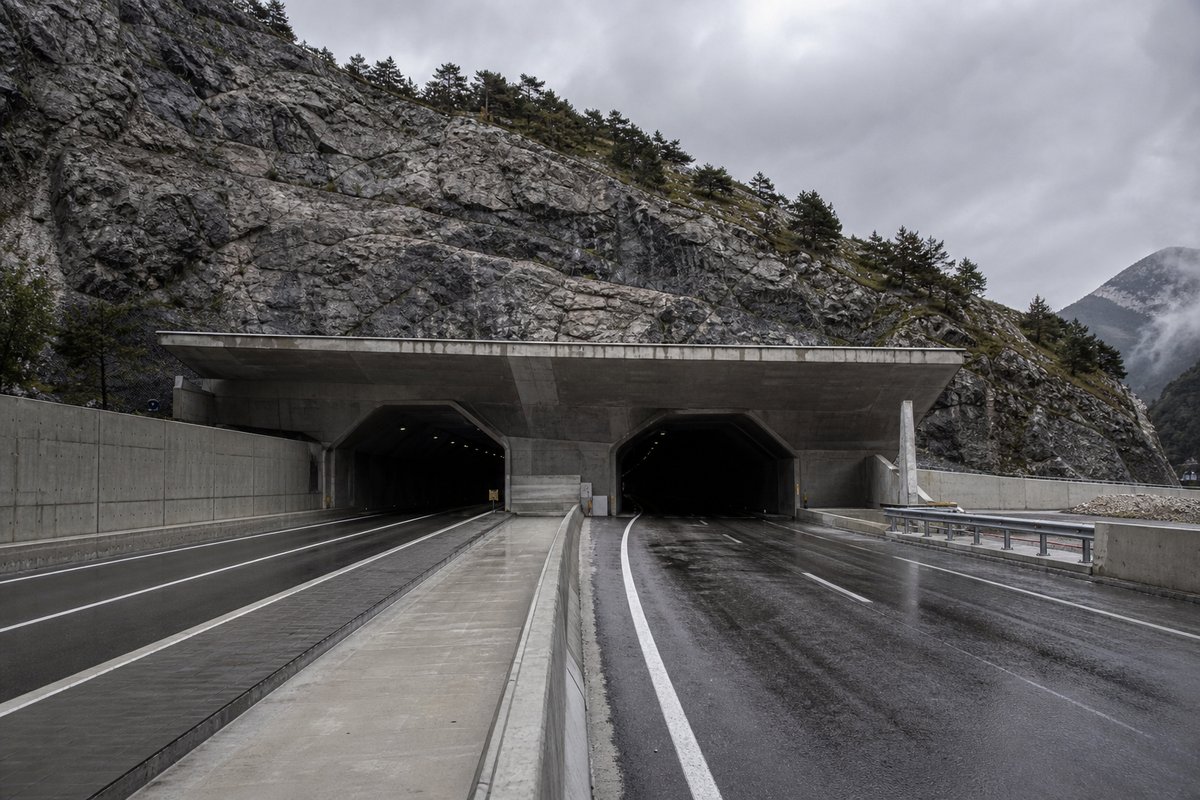
Zigana opened in 2023 and Muzhailing 1 years later in 2024, and that gap usually matters more than the length difference. The median road tunnel in this archive measures 12.46 km, so both entries here are well clear of the ordinary case and the comparison is between two outliers rather than two typical crossings.
Neither holds the record: Laerdal at 24.51 km is the longest road tunnel recorded here, 9.28 km ahead of Muzhailing. Muzhailing is 1.05 times the length of Zigana, and it is the ratio rather than the 0.75 km that says how differently the two crossings had to be ventilated and escaped.
A 1-year gap spans real changes in ventilation, escape provision and excavation method, so the two were not built to the same standard. This archive separates 4 classes of structure and both entries here are indexed under road tunnel, which decides the table each is ranked in and the convention its length was measured by.
- 5entries listed
Side by side
Muzhailing is recorded on data/tun10.html and Zigana on data/tun10.html, compiled to the same convention, which is what makes the two figures comparable at all.
How this archive measures: lengths, bores, dates and ordering
| Measure | Muzhailing | Zigana |
|---|---|---|
| Length | 15.23 km | 14.48 km |
| Length in metres | 15 226 m | 14 476 m |
| Opened | 2024 | 2023 |
| Class | road tunnel | road tunnel |
| Difference | 0.75 km longer | — |
How this table is compiled
Muzhailing and Zigana are compared here on the figures this archive records for each, taken from the same sources and the same measurement convention. Driven end to end the two would run 29.7 km, which is the figure to hold against the 24.51 km of the longest single road tunnel in the record.
Muzhailing is the longer of the two at 15.23 km, ahead of Zigana at 14.48 km, a difference of 0.75 km. Both rows are reachable from the road tunnel table they were taken from, where the note column carries the tube count, the gradient and any reconstruction Muzhailing or Zigana has had.
Both belong to the 2020s, so the two were specified against the same expectations and the length difference is not standing in for a change of era. 18 other structures in this record opened within two years of Muzhailing, which is the cohort it was designed alongside and the fairer comparison for how it was built.
Across every class this archive records, Muzhailing stands 69th by length and Zigana 82nd, so the pair sits inside the top 82 of 244 structures. Counting every class, 12 recorded structures fall between these two by length; the comparison is a window on that part of the record rather than a gap in it.
The 2020s account for 26 entries in this archive, and Zigana is one of them, which is the context a single opening date does not carry on its own. Both pass ten kilometres, which 161 of the 244 structures recorded here manage, so this is a comparison inside a small group rather than across the field.
Reading the figures
That gap is about 5 per cent of the longer bore, which is the figure worth holding on to rather than the raw metres. Only structures open to traffic are compared. A crossing driven from both ends meets in the middle, and the survey needed to make that happen is invisible in the finished figure.
Both are recorded in this archive as road tunnels, so the measurement convention is identical and the comparison is direct. 68 recorded structures are longer than Muzhailing, the nearest of them Firenzuola at 15.29 km. Geology decides cost and programme far more than distance does, so a shorter bore through difficult ground can be the greater achievement.
Muzhailing was designed under the modern regime, with cross-passage spacing and emergency ventilation specified from the outset. Tunnels are regularly repurposed, and the mode a bore was built for is not always the mode it now carries. Trade reporting is faster than official publication and less reliable, which is why opening dates sometimes move after the event.
Among the road tunnels this archive records, Muzhailing stands 10th by length and Zigana 11th, adjacent in the ranking. Pressure waves in a long rail tunnel are severe enough to require relief shafts or sealed carriages. A tunnel outlives the traffic forecast that paid for it, and most of its lifetime cost is ventilation and lighting.
A record only moves when one project completes. A ruling gradient set by the heaviest train decides whether a rail crossing needs a tunnel at all. Gradient limits are the main reason a railway crossing runs longer than a road crossing of the same range. Class conventions differ, so like is compared with like.
Questions about this record
Which is longer, Muzhailing or Zigana?
Muzhailing, at 15.23 km against 14.48 km — a difference of 0.75 km, or 5 per cent of the longer bore. Both are portal-to-portal figures as published by the operator or the responsible administration.
Was Muzhailing harder to build than Zigana?
Not necessarily, and its 0.75 km of extra length is the weakest evidence available. Geology, water and the number of headings decide difficulty; Zigana at 14.48 km may well have been the harder job, and nothing in a length column would show it.
Which of the two opened first?
Zigana, in 2023, 1 years before Muzhailing in 2024. Both dates are the admission of traffic, so Zigana was already carrying it while Muzhailing was still being driven.
Are the two figures measured the same way?
Yes. Both are recorded in this archive as road tunnels, portal to portal along the carriageway or track centre line, in metres, as published by the operator or the responsible administration.
Other pages in this section
- Arlberg vs Daliangshan No: length, opening date and class compared
- Bømlafjord vs Qing-Huang: length, opening date and class compared
- Changxing vs Bømlafjord: length, opening date and class compared
- Chunnel vs Yulhyeon: length, opening date and class compared
- Daliangshan No vs Muzhailing: length, opening date and class compared
- Eiksund vs Karmøy: length, opening date and class compared
- Gotthard Base vs Sei-kan: length, opening date and class compared
- Tunnel comparisons: length, depth and opening date, side by side
- Jinpingshan vs St. Gotthard / San Gottardo: length and opening date
- Karmøy vs Oslofjord: length, opening date and class compared
- Koralm vs New Guanjiao: length, opening date and class compared
- Laerdal vs Gotthard Base: length, opening date and class compared
- Laerdal vs Ryfylke: length, opening date and class compared
- Lötschberg vs Koralm: length, opening date and class compared
- Mont-Blanc / Monte Bianco vs Fréjus: length, opening date, class
- New Guanjiao vs Guadarrama: length, opening date and class compared
- Qing-Huang vs Eiksund: length, opening date and class compared
- Ryfylke vs Eiksund: length, opening date and class compared
- Sandoy vs Tokyo Aqua: length, opening date and class compared
- Sei-kan vs Chunnel: length, opening date and class compared
- Shanghai Airport Link vs Songshan Lake: length and opening date
- Shenzhen vs Lötschberg: length, opening date and class compared
- Simplon-I vs Fréjus: length, opening date and class compared
- Songshan Lake vs Shenzhen: length, opening date and class compared
- St. Gotthard / San Gottardo vs Laerdal: length, opening date, class
- St. Gotthard / San Gottardo vs Tiantaishan: length and opening date
- Tianshan Shengli vs Laerdal: length, opening date and class compared
- Tianshan Shengli vs Yamate: length, opening date and class compared
- Tiantaishan vs Arlberg: length, opening date and class compared
- Tokyo Aqua vs Changxing: length, opening date and class compared
- Yamate vs Zhongnanshan: length, opening date and class compared
- Yulhyeon vs Shanghai Airport Link: length, opening date and class
- Zhongnanshan vs Jinpingshan: length, opening date and class compared
- Zhongnanshan vs Laerdal: length, opening date and class compared
Cite this page
Muzhailing vs Zigana: length, opening date and class compared. The World's Longest Tunnels. https://www.lotsberg.net/compare/muzhailing-vs-zigana.html
Related record tables
- Tunnel comparisons: length, depth and opening date
- Laerdal vs Gotthard Base: length and opening date
- Laerdal vs Ryfylke: length and opening date
- St. Gotthard / San Gottardo vs Laerdal: length and opening year
- Mont-Blanc / Monte Bianco vs Fréjus: length and opening date
- Zhongnanshan vs Laerdal: length and opening date
- Tianshan Shengli vs Laerdal: length and opening date
- Yamate vs Zhongnanshan: length and opening date
- Ryfylke vs Eiksund: length and opening date
- Simplon-I vs Fréjus: length and opening date
- Tianshan Shengli vs Yamate: length and opening date
- Zhongnanshan vs Jinpingshan: length and opening date