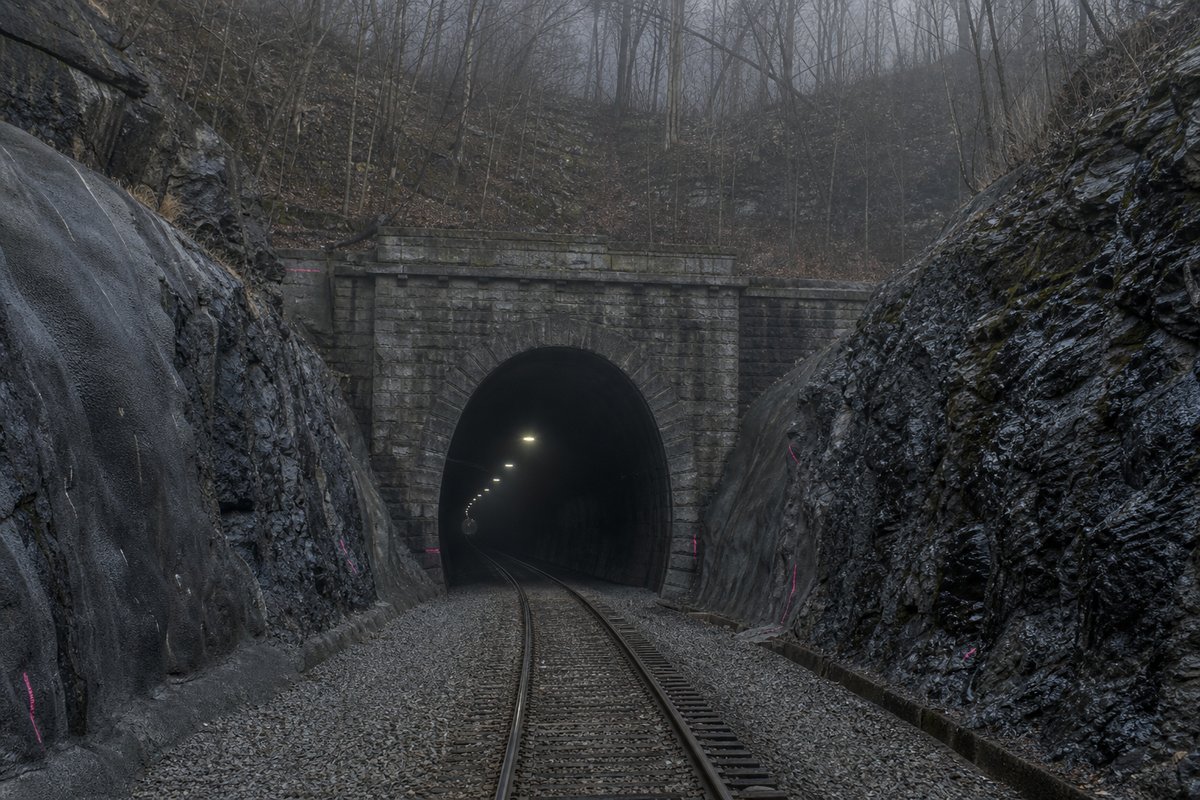
This page records the railway tunnels catalogued for the United States in a tunnel almanac maintained at this address since the late 1990s. Lengths for the United States are recorded in metres which is how the operators publish them and why the shortest entry here reads as 2 557 m and not a rounded figure.
The table below lists 5 entries with a recorded length, each giving a name, a length in metres and, where documented, the year of opening. The median entry measures 10 km, so half the table sits below that and half above, which is a better guide to the typical structure here than the headline figure.
Dated entries run from 1876 to 1970, and the busiest decade is the 1920s with 2 recorded openings. The material on this page is held in 4 captions rather than in running text, 39 words of it, each written against the image or row it belongs to by the compiler who put the page together.
- 5entries listed
- 12.54 kmlongest bore
- 1876–1970openings span
- 44.04 kmtotal length
The record table
How this archive measures: lengths, bores, dates and ordering
| Tunnel | Length | Date of opening | Line, comment |
|---|---|---|---|
| New Cascade | 12 537 m | 12.01.1929 | Great Northern Railway, Cascade mountain range, Washington |
| Flathead | 11 300 m | 1970 | |
| Moffat | 9 996 m | 02.1928 | Denver, Colorado - Salt Lake City, Utah. 2 822 m above sea level |
| Hoosac | 7 645 m | 1876 | Boston - Troy, Berkshire mountain range, Massachusetts |
| Detroit River, Windsor | 2 557 m | 10.1910 | The World's 1st immersed tube (Canada - USA). Length of immersed tube segments: 813 m. |
How this table is compiled
Roughly 0 of the dated entries opened in this century, which is a rough measure of how much of the network is recent. The captions name 13 distinct places and structures — Northern, Railway and Cascade among them — and those names are the index into the length tables where each is recorded with its own figure.
The middle half of the table runs from 5.1 km to 11.92 km, and that band is where most of the engineering on this page actually sits. The longest entry is 4.9 times the shortest and 1.3 times the median, which is the quickest measure of how uneven the table is.
The longest entry is New Cascade, at 12.54 km, opened in 1929. A tunnel list for the United States reads differently from a neighbouring country's: 4 of these 5 structures pass three kilometres, and the same journey time is bought with one long bore in one country and a dozen short ones in another.
The shortest recorded entry is 2.56 km against 12.54 km at the top, a spread of 4.90x across the same table. Where one of these 5 lengths disagrees with an operator's own figure for the United States, the table keeps the published value and notes the difference instead of averaging the two.
4 of the 5 measured entries exceed five kilometres, and those are the ones that carry a full ventilation and escape regime. Laid end to end the entries on this page would run 44.04 km, which is a number with no engineering meaning but a useful sense of the scale of what is catalogued.
Reading the figures
A new scheme in the United States would have to beat 12.54 km to change the head of this table, and that is the figure worth rechecking when one opens. Dates for the United States refer to opening to traffic, not breakthrough, so the 1876 entry was under construction for some years before that.
The earliest dated entry is Hoosac, opened in 1876, and the most recent is Flathead in 1970. Read down the length column, the 5 values run from 2 557 m to 12 537 m with a midpoint at 9 996 m; the spread rather than the maximum is what says how uneven this set is.
The table on this page runs to 5 rows and records Tunnel, Length, Date of opening and Line, comment for each of them, which is the shape the original compiler chose rather than one imposed here. Tunnel building in the United States is shaped by geology and settlement pattern as much as by transport policy.
The entries sum to roughly 44.04 km of bore, an average of about 8.81 km each, though that average describes no actual row. The tunnel column names 5 distinct entries on this page, New Cascade and Flathead among them, each traceable to the operator or administration record it was taken from.
3 of the 5 entries fall within a quarter of the median length, which is how tightly this particular list clusters around its typical structure. 2 entries sit within ten per cent of the longest, so the head of this record is a close group, not one structure standing clear.
Questions about the United States
What is the longest railway tunnel in the United States?
On the figures recorded here it is New Cascade, at 12.54 km, opened in 1929. It heads a table of 5 entries ordered by bore length, not by span, cost or construction difficulty.
How many railway tunnels are listed for the United States?
5 entries with a recorded length appear on this page, from 2.56 km at the short end to 12.54 km at the top, with the middle of the set around 10 km.
How far back do the opening dates go?
The earliest dated entry opened in 1876 and the most recent in 1970, so this page covers 94 years across 5 distinct opening years. A date here is the opening to traffic, which on these 5 dated rows is one to two years after breakthrough.
What is a typical length among the railway tunnels listed for the United States?
The median entry measures 10 km and the middle half of the table runs from 5.1 km to 11.92 km. The headline figure of 12.54 km is the outlier, not the norm, which is why the median is the more useful number when comparing one national list against another.
When were most of the railway tunnels in the United States built?
The busiest decade recorded here is the 1920s, with 2 openings, then the 1870s with 1, and 0 of the dated entries opened from 2000 onwards. That is 40 per cent of the 5 dated rows in a single decade, which says as much about when the route was funded as about the engineering.
Other pages in this section
Cite this page
Railway Tunnels in the United States — Complete List by Length. The World's Longest Tunnels. https://www.lotsberg.net/data/USA/rail.html
Related record tables
- Railway Tunnels in the United Kingdom — 25 Listed by Length
- BART Tunnels and Tubes in the San Francisco Bay Area
- Bridges and Viaducts in the United States
- Road Tunnels in the United States, Part 000
- Road Tunnels in the United States: Full List by Length
- Railway Tunnels in Canada — 25 Listed by Length
- Railway Tunnels in China — 52 Listed by Length
- Railway Tunnels in China — 25 Listed by Length
- Railway Tunnels in Finland — 35 Listed by Length
- Railway Tunnels in France — 40 Listed by Length
- Railway Tunnels in India — 44 Recorded Entries
- Railway Tunnels in India — 13 Listed by Length