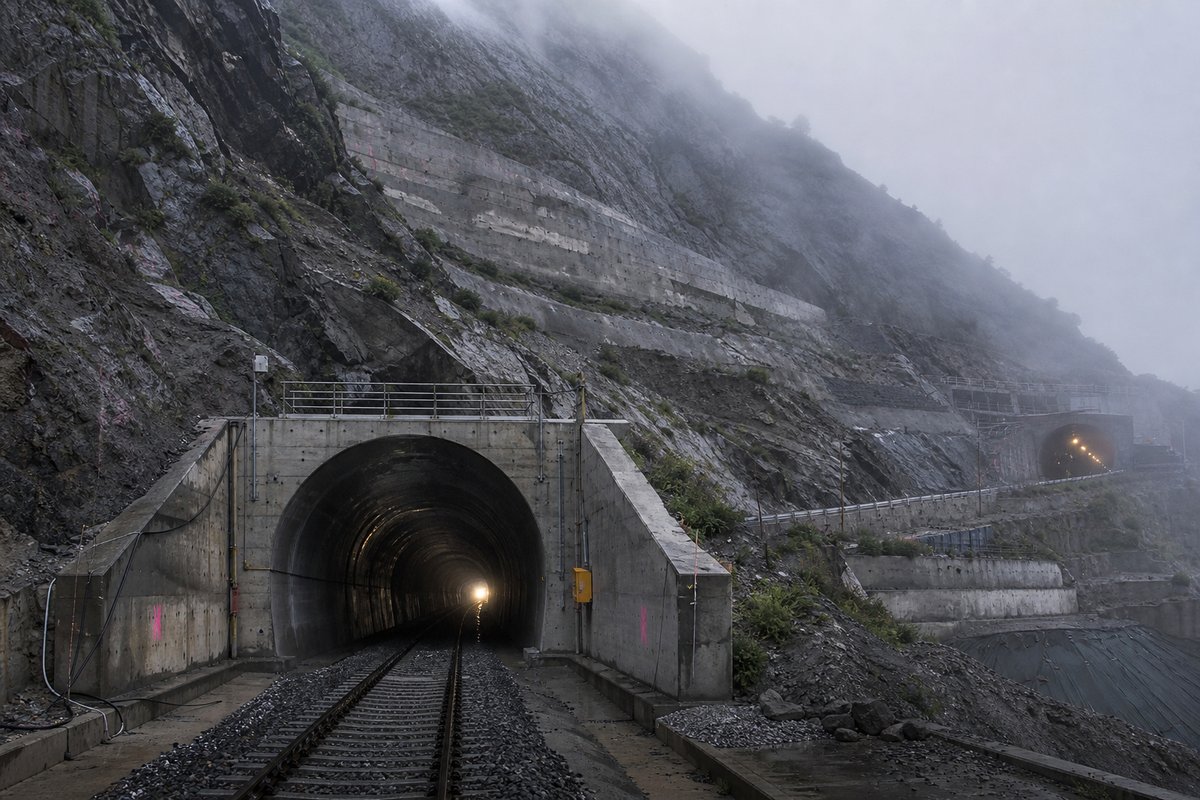
Dates for India refer to opening to traffic, not breakthrough, so the 1903 entry was under construction for some years before that. A tunnel list for India reads differently from a neighbouring country's, because the same journey time can be bought with one long bore in one country and a dozen short ones in another.
The dated entries fall across 2 different years, which is a rough measure of whether this was a sustained programme or a handful of separate schemes. A viaduct is measured along its deck and a bridge by its main span, and confusing the two is the commonest error in a bridge list.
This page records the railway tunnels catalogued for India in a tunnel almanac maintained at this address since the late 1990s. Dated entries run from 1903 to 1998, and the busiest decade is the 1990s with 27 recorded openings. Base tunnels driven low through a massif appear here beside the older summit tunnels they replaced.
- 32entries listed
- 1903–1998openings span
- 28.59 kmtotal length
The record table
How this archive measures: lengths, bores, dates and ordering
| — | Railways Tunnels in India < 2 000 m | — | — | — |
|---|---|---|---|---|
| Edited by: Eugenio A. Merzagora | ||||
| 2 nd revision - April 2004 | ||||
| Tunnel | Length (m) | Date of opening | Region | Line, section |
| Shinde Ambri | 1 972 | 1998 | MH | Konkan Railway |
| Byndoor | 1 962 | 1998 | KA | Konkan Railway |
| Parsik | 1 950 | MH | Thane - Kalyan line (India first rail tunnel) | |
| Padi | 1 917 | 1998 | GA | Konkan Railway |
| Shiravali | 1 734 | 1998 | MH | Konkan Railway |
| Pernem | 1 561 | 1998 | GA | Konkan Railway |
| Bhirkond | 1 291 | 1998 | MH | Konkan Railway |
| Math | 1 267 | 1998 | MH | Konkan Railway |
| Honnavar | 1 225 | 1998 | KA | Konkan Railway |
| Gopalwadi | 1 208 | 1998 | MH | Konkan Railway |
| Ambed | 1 208 | 1998 | MH | Konkan Railway |
| Barog | 1 144 | 09.11.1903 | HP | Kalka - Shimla line |
| Tiware | 1 095 | 1998 | MH | Konkan Railway |
| Khershet | 1 050 | 1998 | MH | Konkan Railway |
| Aravali | 1 050 | 1998 | MH | Konkan Railway |
| Ashti | 1 020 | 1998 | MH | Konkan Railway |
| Nilik | 1005 | 1998 | MH | Konkan Railway |
| Lajul | 943 | 1998 | MH | Konkan Railway |
| Shirsavane | 906 | 1998 | MH | Konkan Railway |
| Velewadi | 894 | 1998 | MH | Konkan Railway |
| Agave | 894 | 1998 | MH | Konkan Railway |
| Ranpat | 866 | 1998 | MH | Konkan Railway |
| Bhatkal | 864 | 1998 | KA | Konkan Railway |
| Loliem | 836 | 1998 | KA | Konkan Railway |
| Mudgeri | 835 | 1998 | GA | Konkan Railway |
| Verna | 805 | 1998 | GA | Konkan Railway |
| Kondav I | 758 | 1998 | MH | Konkan Railway |
| Barewadi I | 700 | 1998 | MH | Konkan Railway |
| Koti | 694 | 09.11.1903 | HP | Kalka - Shimla line |
| Sarzora II | 655 | 1998 | GA | Konkan Railway |
| Old Goa | 544 | 1998 | GA | Konkan Railway |
| Tara Devi | 492 | 09.11.1903 | HP | Kalka - Shimla line |
| N103 | 346 | 09.11.1903 | HP | Kalka - Shimla line |
| Daulatpur | 305 | HP | Kangra Valley line | |
| Dasgaon | 294 | 1998 | MH | Konkan Railway |
| Ukshi | 104 | 1998 | MH | Konkan Railway |
| ? | 97 | Nilgiri Mountain line | ||
| Dhudni | 76 | HP | Kangra Valley line | |
| Other 98 shorter tunnels | 09.11.1903 | HP | Kalka - Shimla line | |
| Other 8 shorter tunnels | Nilgiri Mountain line |
How this table is compiled
Roughly 0 of the dated entries opened in this century, which is a rough measure of how much of the network is recent. Openings average one every 3.2 years across the dated entries here, though they arrive in clusters, not at that rate. Railway tunnel lengths are taken along the track centre line.
A freight route's ruling gradient is set by the heaviest train it must lift, and that single figure decides whether a tunnel is needed at all. A ranking of this kind moves whenever a single large scheme opens, and nothing on a stale page announces that a longer structure now exists elsewhere.
The 1990s account for 27 openings here and the 1900s for 4, so the building effort was not spread evenly across the period. Single-track bores built as a pair are recorded individually, since treating them as one structure would misstate both the engineering and the cost. A referendum has stopped more alpine schemes than geology has.
Tunnel building in India is shaped by geology and settlement pattern as much as by transport policy. A projected opening date is a forecast, and on large schemes forecasts have historically slipped by years. A railway tunnel is sized by the loading gauge, and a bore built for one country's rolling stock can refuse another's.
Gradient inside a road tunnel is kept gentle for heavy vehicles, which lengthens the bore to gain the same height. Administrative boundaries have been redrawn in several countries since these lists were first assembled. The oldest entries in any national list are usually canal or rail, because roads were the last mode to need long bores.
Reading the figures
Toll revenue on a fixed link is usually pledged against the debt that built it, and the toll ends when the debt does. Gradient limits are the main reason rail tunnels run longer than road tunnels on the same crossing. A ranking answers the question people arrive with and rarely the one they leave with.
Nineteenth-century tunnels were surveyed from the surface with theodolites and chains, and the best of them met within centimetres. A record is a statement about what has been published, not about what exists. Trade press reporting is faster than official publication and less reliable, which is why an opening date sometimes moves after the event.
Escape and rescue provision has driven most of the change in tunnel design over the past three decades. A hard shoulder inside a tunnel is expensive width, and its absence is why breakdowns are treated as emergencies. Widening an existing bore is rarely economic, so capacity is usually added by driving a second one alongside.
The fires of the late 1990s and early 2000s reshaped European tunnel safety regulation permanently. Dates before 1900 are frequently approximate, and are shown as published, unreconciled. Traffic signals inside a tunnel exist to stop vehicles entering behind an incident, and they are the cheapest safety system on the list.
Some entries carry a range instead of a single value where the two carriageways differ. The first railway tunnels were driven by hand and gunpowder, and their alignments still carry the marks of both. The note column is often the most useful part of a row, recording tube counts, gradients, closures and reconstruction dates.
Questions about India
How far back do the opening dates go?
The earliest dated entry opened in 1903 and the most recent in 1998, so this page covers 95 years. A date here is the opening to traffic, which on these 31 dated rows is one to two years after breakthrough.
When were most of the railway tunnels in India built?
The busiest decade recorded here is the 1990s, with 27 openings, then the 1900s with 4, and 0 of the dated entries opened from 2000 onwards. That is 87 per cent of the 31 dated rows in a single decade, which says as much about when the route was funded as about the engineering.
What counts as one railway tunnel on this page?
A single continuous bore between its own portals. Where a route is made up of several consecutive tunnels each is listed on its own row and not summed into one headline figure, so a motorway whose separate tunnelled sections are added together elsewhere appears here as its individual structures.
How is the India material sourced?
From the operator or the administration responsible for India, cross-checked against a second published figure where the two disagree. The measurement and dating conventions that apply across the whole record are set out once on the method page, not repeated here.
Other pages in this section
Cite this page
Railway Tunnels in India — Complete List by Length. The World's Longest Tunnels. https://www.lotsberg.net/data/india/rail-2.html
Related record tables
- Railway Tunnels in the United Kingdom — 25 Listed by Length
- Railway Tunnels in the United States — 5 Listed by Length
- Railway Tunnels in Canada — 25 Listed by Length
- Railway Tunnels in China — 52 Listed by Length
- Railway Tunnels in China — 25 Listed by Length
- Railway Tunnels in Finland — 35 Listed by Length
- Railway Tunnels in France — 40 Listed by Length
- Road Tunnels in India — 12 Listed by Length
- Railway Tunnels in India — 13 Listed by Length
- Railway Tunnels in Japan — 79 Listed by Length
- Railway Tunnels in Norway — 54 Listed by Length
- Railway Tunnels in Switzerland — 44 Listed by Length