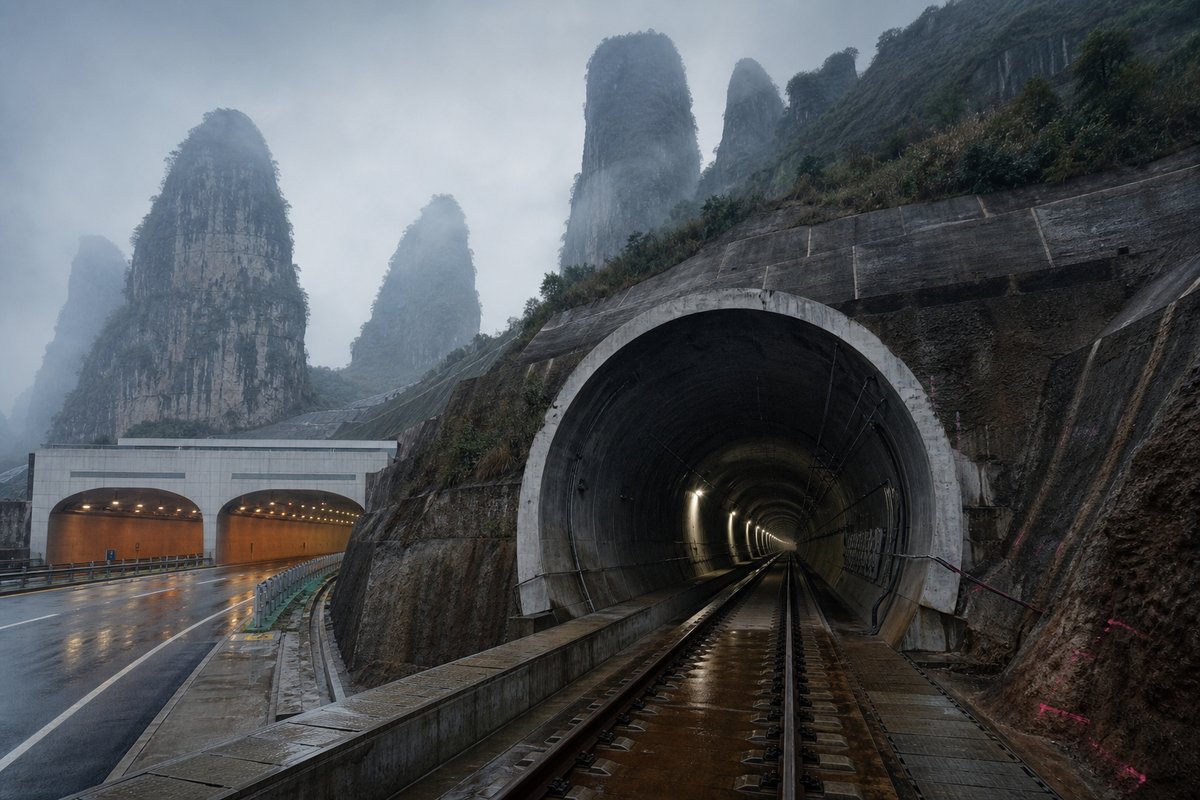
8 of those 52 are recorded as under construction or planned, the longest of them New Gunjiao at 32.65 km, so the count includes them while every measured figure — the range, the median, the total — describes the 44 rows carrying traffic today: an unopened bore cannot hold a record.
The table below lists 52 entries with a recorded length, each giving a name, a length in metres and, where documented, the year of opening. Lengths for China are recorded in metres which is how the operators publish them and why the shortest entry here reads as 10 800 m and not a rounded figure.
The median entry measures 15.59 km, so half the table sits below that and half above, which is a better guide to the typical structure here than the headline figure. The shortest recorded entry is 10.8 km against 28.24 km at the top, a spread of 2.61x across the same table.
- 52entries listed
- 28.24 kmlongest bore
- 1987–2015openings span
- 728.88 kmtotal length
The record table
How this archive measures: lengths, bores, dates and ordering
| Tunnel | Length (m) | Date of opening | Province | Notes |
|---|---|---|---|---|
| New Gunjiao | 32 645 | u.c. | QH | Second tube: 32645 m. Xining - Golmud Line |
| West Quinling | 28 240 | 2013 | GA | Second tube: 28240 m. Lanzhou - Chongqing Line |
| Taihang | 27 900 | 2007 | SH | Second tube: 27900 m. S hijiazhuang-Taiyuan High-Speed Railway |
| South Luliangshan | 23 464 | 2014 | SH | Second tube: 23441 m. Shanxi Central - South Line |
| Middle Tianshan | 22 452 | 2012 | XU | Second tube: 22452 m. Turpan - Kuqa 2nd Line |
| Qingyunshan | 22 175 | 2012 | FU | Second tube: 22175 m. Xiangtang - Putian Railway |
| Wushaoling | 21 050 | 30.03.2006 23.08.2007 | GA | Second tube: 21050 m. Lanzhou - Ürümqi Railway |
| Luliangshan | 20 800 | 2010 | SH | Second tube: 20800 m. Taiyuan - Zhongwei - Yinchuan Railway |
| Muzhailing | 19 080 | 2013 | GA | Second tube: 19080 m. Lanzhou - Chongqing Railway |
| Qinling I-II | 18 457 | 08.01.2002 | SX | Second tube: 18457 m. Xi'an - Ankang Railway |
| Shilin | 18 218 | u.c. | YU | Kunming - Nanning Railway |
| Taihangshan | 18 125 | 2014 | SH | Second tube: 18125 m. Shanxi Central - South Railway |
| Xuefengshan | 17 892 | 2012 | FU | Second tube: 17892 m. Xiangtang - Putian Railway |
| Xiuling | 17 623 | 2013 | YU | Second tube: 17623 m. Dali - Ruili Railway |
| Gaoganshan | 17 612 | 2012 | FU | Second tube: 17612 m. Xiangtang - Putian Railway |
| Zhongtiaoshan | 17 350 | u.c. | SH | Second tube: 17350 m. Yuncheng-Sanmengxia Railway |
| Yongshouliang | 17 160 | 2012 | SX | Xi'an - Pingliang Railway |
| Liupanshan | 16 719 | 2012 | GA | Tianshui-Pingliang Railway |
| Hadapu | 16 600 | 2013 | GA | Second tube: 16600 m. Lanzhou-Chongqing Railway |
| Taiyueshan | 16 194 | 2014 | SH | Second tube: 16194 m, Shanxi Central - South Railway |
| Fajiushan | 16 007 | 2014 | SH | Second tube: 16007 m. Shanxi Central-South Railway |
| Xiangshan | 15 901 | 201 1 | FU | S econd tube: 15901 m. Longyan - Xiamen Railway |
| Erqingshan | 15 851 | 2013 | SH | Second tube: 15851 m. Taiyuan - Xingxian Railway |
| Heishan | 15 764 | 2013 | GA | Second tube: 15764 m. Lanzhou-Chongqing Railway |
| Daiyunshan | 15 623 | 201 2 | FU | Second tube: 15623 m. Xiangtang - Putian Railway |
| Guanshan | 15 550 | 2012 | GA | One tube on Tianshui - Pingliang Railway |
| Liulangshan | 15 175 | 2012 | SH | One tube on Zhungeer - Shuozhou Railway |
| Maotianshan | 14 915 | 2011 | SX | One tube on Baotou - Xi'an Railway |
| Dapoling | 14 728 | 2013 | YU | Second tube: 14728 m. Dali-Ruili Railway |
| Bibanpo | 14 700 | 2015 | YU | Second tube: 14700 m. Shanghai-Kunming HSR |
| Yanshan | 14 695 | GU | Second tube: 14695 m. Guiyang-Guangzhou HSR | |
| Wuyishan | 14 659 | 2012 | FU | One tube on Xiangtang - Putian Railway |
| Dazhushan | 14 625 | 2013 | YU | Second tube: 14625 m. Dali-Ruili Railway |
| Sandu | 14 598 | u.c | GU | Second tube: 14598 m. Guiyang-Guangzhou HSR |
| Tianchiping | 14 528 | GA | Second tube: 14528 m. Lanzhou-Chongqing Railway | |
| Dayaoshan | 14 294 | 1987 | GD | One tube on Beijing - Guangzhou Railroad |
| Jinguashan | 14 097 | 201 2 | FU | S econd tube: 14097 m. Xiangtang - Putian, |
| Yanmengguan | 14 085 | u.c. | SH | One tube, North Datong - Puzhouzhen |
| Tianpingshan | 14 012 | u.c. | GZ | One tube, Guiyang-Guangzhou HSR |
| Tongmashan | 13 929 | u.c. | GU | One tube, Guiyang-Guangzhou Railway, |
| Yesanguan | 13 838 | 2009 | HB | One tube, Yichang-Wanzhou Railway |
| Baofengshan | 13 708 | u.c. | GZ | Second tube: 13708 m. Guiyang-Guangzhou HSR |
| Humaling | 13 611 | 2013 | GA | Second tube: 13611 m. Lanzhou - Chongqing Railway |
| North Tianshan | 13 610 | 2009 | XU | Second tube: 13610 m. Jinghe - Yining-Huo Erguosi Railway |
| Wanshoushan | 13 468 | 2012 | CH | Second tube: 13468 m. Chongqing - Lichuan Railway |
| Shanyang | 13 465 | 2013 | YU | Second tube: 13465 m. Dali - Ruili Railway |
| Changhongling | 13 294 | 2012 | YU | Chongqing - Lichuan Railway |
| Dabieshan | 13 256 | 2008 | HB | One tube on Hefei - Wuhan High Speed Railway |
| Anlu | 13 187 | 2008 | YU | Guanglu-Kunming Railway |
| Xiapu | 13 099 | 20 09 | FU | On e tube on Wenzhou-Fuzhou Railway |
| Changliangshan | 12 780 | u.c. | SH | |
| Shiziyang | 10 800 | 2012 | Second tube: 5585 m. The Guangzhou - Shenzhen - Hong Kong express rail link |
| — | Region | Main Town |
|---|---|---|
| CSO | Center South | Wuhan |
| EAS | East | Shanghai |
| NOE | North East | Shenyang |
| NOR | North | Bejing |
| NOW | North West | Xi'an |
| SOW | South West | Chongqing |
| — | Province | Main Town | Region |
|---|---|---|---|
| JX | Jiangxi | Nanchang | CSO |
| LI | Liaoning | Shenyang | NOE |
| NM | Nei Mongol | Hohhot | NOE |
| NU | Ningxia Hui | Yinchuan | NOW |
| QH | Qinghai | Xining | NOW |
| SD | Shandong | Jinan | EAS |
| SG | Shangai | Shangai | EAS |
| SH | Shanxi | Taiyuan | NOR |
| SI | Sichuan | Chengdu | SOW |
| SX | Shaanxi | Xi'an | NOW |
| TB | Xizang (Tibet) | Lhasa | SOW |
| TT | Tianjin (Tientsin) | Tianjin | NOR |
| XU | Xinjiang Uygur | Urumqi | NOW |
| YU | Yunnan | Kunming | SOW |
| ZJ | Zhejiang | Hangzhou | EAS |
How this table is compiled
The middle half of the table runs from 14.15 km to 17.82 km, and that band is where most of the engineering on this page actually sits. Between the longest and the tenth-longest the drop is 10.12 km, which is the part of the table that changes when a single scheme opens.
The three longest entries alone account for 79.6 km of the 728.88 km on this page, which is 11 per cent of the total from 3 of 44 rows. 22 entries sit above the median and 22 at or below it, so the table is evenly weighted and not clustered at one end.
Where one of these 44 lengths disagrees with an operator's own figure for China, the table keeps the published value and notes the difference instead of averaging the two. The 44 rows for China are ordered by length, not by date, so the 2015 opening sits well down the table without being any less current.
A new scheme in China would have to beat 28.24 km to change the head of this table, and that is the figure worth rechecking when one opens. The longest entry is 2.6 times the shortest and 1.8 times the median, which is the quickest measure of how uneven the table is.
Second and third place go to Taihang at 27.9 km and South Luliangshan at 23.46 km. The table on this page runs to 52 rows and records Tunnel, Length (m), Date of opening, Province and Notes for each of them, which is the shape the original compiler chose rather than one imposed here.
Reading the figures
44 of the 44 measured entries exceed five kilometres, and those are the ones that carry a full ventilation and escape regime. Laid end to end the entries on this page would run 728.88 km, which is a number with no engineering meaning but a useful sense of the scale of what is catalogued.
This page records the railway tunnels catalogued for China in a tunnel almanac maintained at this address since the late 1990s. The date of opening column runs from 1987 to 2015 across 39 dated rows, and the 2010s alone account for 32 of them, so the building effort here came in waves rather than evenly.
Dated entries run from 1987 to 2015, and the busiest decade is the 2010s with 29 recorded openings. The material on this page is held in 43 captions rather than in running text, 298 words of it, each written against the image or row it belongs to by the compiler who put the page together.
Roughly 36 of the dated entries opened in this century, which is a rough measure of how much of the network is recent. The captions name 40 distinct places and structures — Railway, Chongqing and Putian among them — and those names are the index into the length tables where each is recorded with its own figure.
Eighth on the list is Muzhailing at 19.08 km, which is where the table stops being about record holders and starts being about ordinary infrastructure. The tunnel column names 52 distinct entries on this page, New Gunjiao and West Quinling among them, each traceable to the operator or administration record it was taken from.
Questions about China
What is the longest railway tunnel in China?
On the figures recorded here it is West Quinling, at 28.24 km, opened in 2013. It heads a table of 52 entries ordered by bore length, not by span, cost or construction difficulty.
How many railway tunnels are listed for China?
52 entries with a recorded length appear on this page, of which 44 carry traffic today and 8 are under construction or planned. The 44 in service run from 10.8 km at the short end to 28.24 km at the top, with the middle of the set around 15.59 km.
How far back do the opening dates go?
The earliest dated entry opened in 1987 and the most recent in 2015, so this page covers 28 years across 12 distinct opening years. A date here is the opening to traffic, which on these 37 dated rows is one to two years after breakthrough.
What is a typical length among the railway tunnels listed for China?
The median entry measures 15.59 km and the middle half of the table runs from 14.15 km to 17.82 km. The headline figure of 28.24 km is the outlier, not the norm, which is why the median is the more useful number when comparing one national list against another.
When were most of the railway tunnels in China built?
The busiest decade recorded here is the 2010s, with 29 openings, then the 2000s with 7, and 36 of the dated entries opened from 2000 onwards. That is 78 per cent of the 37 dated rows in a single decade, which says as much about when the route was funded as about the engineering.
Other pages in this section
Cite this page
Railway Tunnels in China — Complete List by Length. The World's Longest Tunnels. https://www.lotsberg.net/data/china/rail.html
Related record tables
- Railway Tunnels in the United Kingdom — 25 Listed by Length
- Railway Tunnels in the United States — 5 Listed by Length
- Railway Tunnels in Canada — 25 Listed by Length
- Road Tunnels in China — 81 Listed by Length
- Railway Tunnels in China — 25 Listed by Length
- Railway Tunnels in Finland — 35 Listed by Length
- Railway Tunnels in France — 40 Listed by Length
- Railway Tunnels in India — 44 Recorded Entries
- Railway Tunnels in India — 13 Listed by Length
- Railway Tunnels in Japan — 79 Listed by Length
- Railway Tunnels in Norway — 54 Listed by Length
- Railway Tunnels in Switzerland — 44 Listed by Length