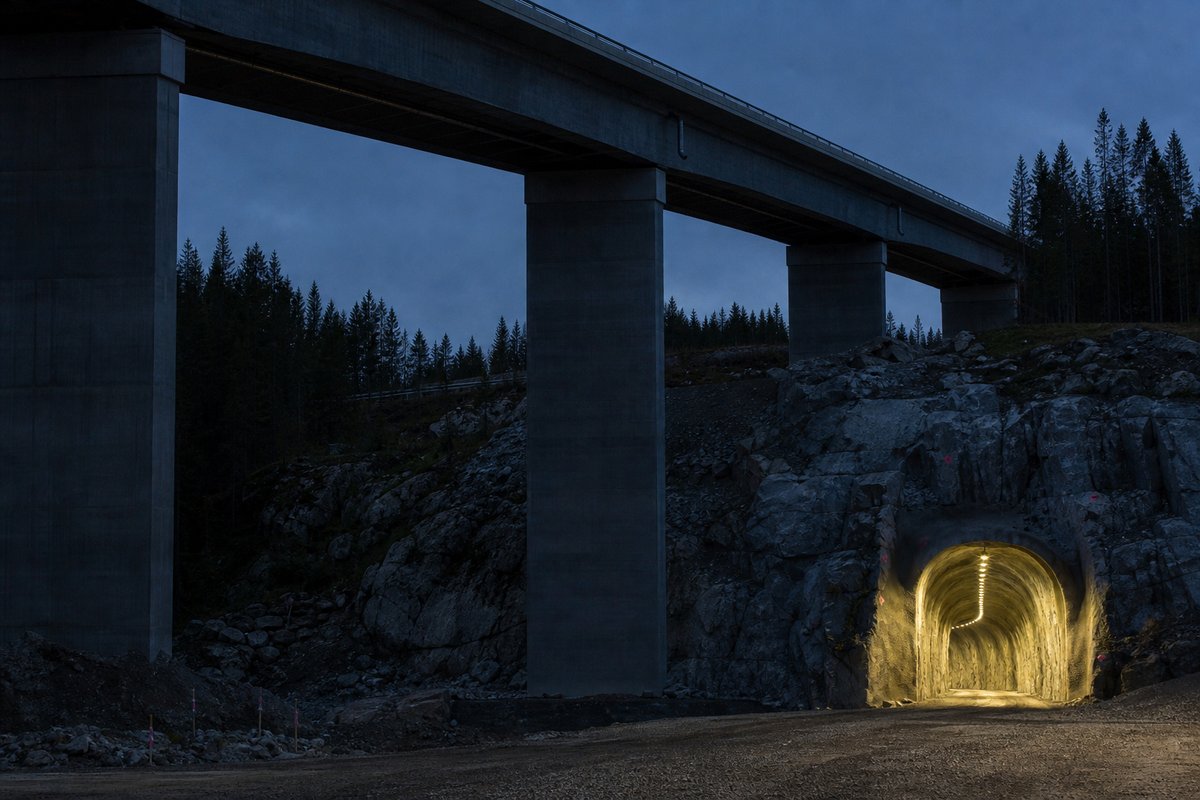
This page records the bridges and viaducts catalogued for Finland in a tunnel almanac maintained at this address since the late 1990s. A tunnel list for Finland reads differently from a neighbouring country's, because the same journey time can be bought with one long bore in one country and a dozen short ones in another.
The table on this page runs to 7 rows and records No., Bridge, Span, Location and Country for each of them, which is the shape the original compiler chose rather than one imposed here. A railway tunnel is sized by the loading gauge, and a bore built for one country's rolling stock can refuse another's.
The year column runs from 1937 to 1997 across 7 dated rows, and the 1990s alone account for 3 of them, so the building effort here came in waves rather than evenly. Segmental linings arrive precast and are bolted up behind the machine, so the finished bore appears at the same rate the face advances.
The record table
How this archive measures: lengths, bores, dates and ordering
| No. | Bridge | Span | Location | Country | Year | Notes |
|---|---|---|---|---|---|---|
| 1 | Kirjalansalmi | 220 | Parainen | Finland | 1963 | |
| 2 | Sääksmäki | 155 | Valkeakoski | Finland | 1963 | |
| CABLE-STAYED BRIDGES | ||||||
| No. | Bridge | Span | Location | Country | Year | Notes |
| 1 | Raippaluoto | 250 | Vaasa | Finland | 1997 | |
| 2 | Kärkinen | 240 | Korpilahti | Finland | 1997 | |
| STEEL BOX GIRDER BRIDGE | ||||||
| No. | Bridge | Span | Location | Country | Year | Notes |
| 1 | Saimaa | 140 | Puumala | Finland | 1995 | |
| PRESTRESSED CONCRETE GIRDER BRIDGE | ||||||
| No. | Bridge | Span | Location | Country | Year | Notes |
| 1 | Norrströmmen | 135 | Nauvo | Finland | 1986 | |
| CONCRETE ARCH BRIDGE | ||||||
| No. | Bridge | Span | Location | Country | Year | Notes |
| 1 | Färjsundet | 134 | Saltvik | Finland | 1937 | |
| Updated 6.6.1999 | Copyright å 2002 Juhani Virola | Maintained by LBE |
How this table is compiled
Read down the span column, the 7 values run from 134 m to 250 m with a midpoint at 155 m; the spread rather than the maximum is what says how uneven this set is. Switzerland's crossings are alpine and its practice is conservative, which shows in how few of its entries have ever been rebuilt.
The bridge column names 7 distinct entries on this page, Kirjalansalmi and Sääksmäki among them, each traceable to the operator or administration record it was taken from. A freight route's ruling gradient is set by the heaviest train it must lift, and that single figure decides whether a tunnel is needed at all.
The 7 entries are grouped on the page under 5 headings — suspension bridges (2), cable-stayed bridges (2), steel box girder bridge (1), prestressed concrete girder bridge (1) and concrete arch bridge (1) — a classification the table carries as section breaks rather than as a column of its own. Deck length is the figure route engineers and structure inventories work with.
Water under pressure is the single most disruptive thing a heading can meet, and it is rarely where the survey said it would be. Geology decides cost and programme far more than distance does; a short bore through squeezing ground can take longer than a long one through sound rock.
Bridges and viaducts are listed by total deck length, not by main span. A long viaduct on modest piers can therefore outrank a shorter but far more dramatic single-span crossing. Bridge and tunnel appear on the same route more often than either appears alone, because the terrain that requires one usually requires the other.
Reading the figures
Tunnel building in Finland is shaped by geology and settlement pattern as much as by transport policy. Wartime damage closed several crossings for years, and a few were never reopened to their original use. Seismic risk changes the lining rather than the alignment: a tunnel is among the safer places to be in an earthquake.
Aerodynamic pressure waves in a long rail bore are severe enough to need relief shafts or sealed carriages. Norway builds more subsea road tunnels than anywhere else because its coast is deep, its islands are populated and a bridge would not reach. Older entries were compiled from printed sources and correspondence, not from online publication.
Fixed links change settlement patterns, so the traffic a crossing carries after ten years is not the traffic it was justified on. Toll plazas sit outside portals rather than inside them, for ventilation reasons as much as for traffic ones. Toll arrangements are excluded here, because they change far more often than the structures do.
Alpine countries dominate the rail column and coastal ones the subsea column, and neither is an accident of compilation. Two administrations measuring the same crossing will agree on the rock and differ on the approaches. Metro tunnels are shallow, closely spaced and built under streets, which makes them a different engineering problem from an alpine crossing.
De-icing is a portal problem rather than a tunnel one: the bore stays above freezing long after the approach road does not. Round numbers in an old list are usually estimates that hardened into record over time. A scheme abandoned half-built leaves a heading that shows on no map and turns up during the next survey.
Questions about Finland
What does the table on this page list?
16 rows, one per no., with bridge, span, location, country. The columns are the archive's own, and a blank cell means the value was never published rather than zero.
What counts as one bridge on this page?
A single continuous bore between its own portals. Where a route is made up of several consecutive tunnels each is listed on its own row and not summed into one headline figure, so a motorway whose separate tunnelled sections are added together elsewhere appears here as its individual structures.
How is the Finland material sourced?
From the operator or the administration responsible for Finland, cross-checked against a second published figure where the two disagree. The measurement and dating conventions that apply across the whole record are set out once on the method page, not repeated here.
Other pages in this section
Operators and administrations
- The World's longest bridges aalto.fi
This page listed 5 external addresses; one of them still holds the material they were listed for and is shown above. The other 4 were checked against the content of the page each leads to, not merely its status code, and did not survive it.
Cite this page
Bridges and Viaducts in Finland by Deck Length. The World's Longest Tunnels. https://www.lotsberg.net/data/finland/bru.html
Related record tables
- Bridges and Viaducts in the United States
- Bridges and Viaducts in Denmark — 44 Listed by Length
- Railway Tunnels in Finland — 35 Listed by Length
- Bridges and Viaducts in France — 42 Listed by Length
- Bridges and Viaducts in Italy — 345 Listed by Length
- Bridges and Viaducts in Italy — 219 Listed by Length
- Bridges and Viaducts in Italy — 239 Listed by Length
- Bridges and Viaducts in Norway — 58 Listed by Length
- Bridges and Viaducts in Norway — 59 Listed by Length
- Bridges and Viaducts in Austria — 57 Listed by Length
- Bridges and Viaducts in Germany — 37 Listed by Length
- Bruer og viaduktar i Noreg, etter lengd på brubana