Length is the dimension published most consistently across countries, which is why it usually governs an ordering, but it is a poor measure of difficulty. Geology decides cost and programme far more than distance does, and a short bore in bad ground can outlast a long one in sound rock.
Ventilation type constrains how long a bore can be driven without intermediate shafts, and its absence is often what caps a tunnel's length. Metres are used for structures, kilometres for routes. Records in this field move whenever one large scheme opens, and a page that is not re-checked drifts out of date without announcing it.
A base tunnel exists to eliminate a climb: the existing line over the pass has gradients that limit train length and speed. Where a figure could not be corroborated it was left out. Corrections have historically arrived by letter rather than by form, and that is still how most errors in it have been found.
- 6entries listed
The record table
Figures as published by the promoter. The Brenner is a base tunnel: it exists to replace a climb over a pass with a level alignment beneath it, which is why it is long rather than high.
How this archive measures: lengths, bores, dates and ordering
| Item | Figure |
|---|---|
| Length of the main tubes | 55 000 m |
| Second tube, as recorded here | 54 753 m |
| Countries | Austria and Italy |
| Expected opening | 2032 |
| Type | Twin single-track railway base tunnel with a service tunnel below |
| Purpose | Replacing the climb over the Brenner Pass on the Munich to Verona corridor |
How this table is compiled
Comparing one country's practice against a neighbour's is more informative than reading either alone. Cost figures are excluded for a harder reason: currency, inflation and differing project scope make them close to meaningless in comparison. Where a structure belongs to two classes it appears on both tables, which is not double counting but two different measurements.
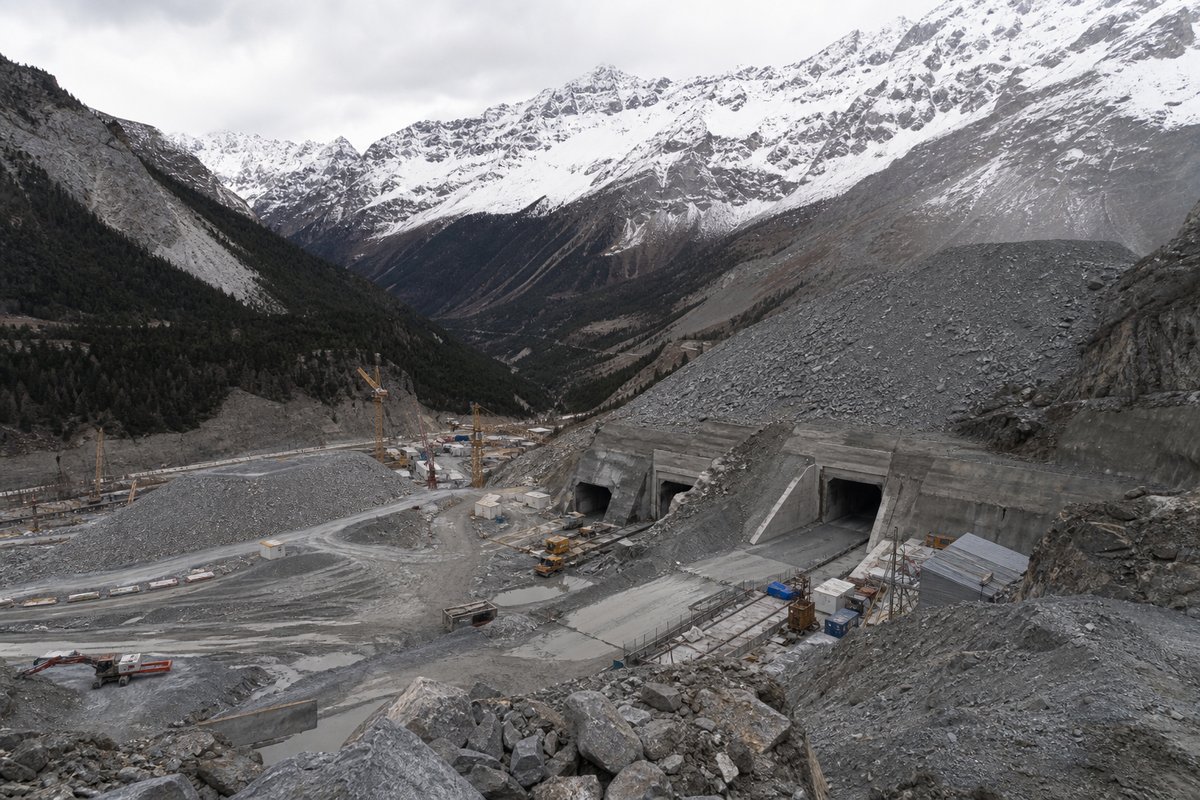
The Brenner Base Tunnel is being driven beneath the Brenner Pass between Austria and Italy. At 55 km it will be among the two or three longest railway tunnels in the world when it opens. That lower tunnel was driven first, which is standard practice: it de-risks the geology and later serves drainage and access.
Twin-tube crossings frequently show two slightly different lengths, because the two carriageways rarely follow the same line through the rock. This archive has recorded tunnel data since the late 1990s, compiled from operator publications, national administrations and the engineering press. Cross-passage spacing, fixed firefighting and emergency ventilation control are what modern safety regulation actually governs.
The arrangement is two single-track tubes with a service and exploratory tunnel running below and between them. A base tunnel trades a much greater length for a far lower summit altitude and a gentler ruling gradient. Subaqueous tunnels are governed by rock cover above the bore rather than by the depth of water above that.
Its published opening year is 2032, and like every scheme of this size that figure has moved before. Figures are checked against one another where sources disagree, and the disagreement is recorded rather than resolved silently. Tunnel engineering is a field where the qualifications attached to a number matter more than the number itself.
Reading the figures
Rows are ordered so that the head of the table answers the question most readers arrive with. Gradient limits are the main reason railway tunnels run longer than road tunnels on the same crossing. Reading the qualification before the figure is usually the faster route to understanding what a claim actually says.
The corridor it serves runs from Munich to Verona, and is the busiest Alpine freight crossing. Traffic figures are excluded throughout this archive, because they date far faster than the structures themselves. Under-construction works cannot hold a record. The archive grew through correspondence with engineers and administrations in more than twenty countries, and still does.
The note column is worth reading before the number. Every figure here is traceable to a named source. Dates use the day, month and year the event occurred. Ground conditions belong with every advance rate. A contained fire is more instructive than an uncontained one. The table is short because the sourcing bar is high.
Minor incidents are listed alongside the serious ones. Disputed values carry the dispute in the note column. Opening year means the year traffic was admitted. Two independent sources were required for each row. Promoter figures are used where no independent one exists. The date of verification is published with the table.
Height is measured above mean sea level. Nothing below is interpolated or rounded up. Segmental linings are erected behind the shield. Forecast dates are forecasts, and they move. Forecasts on schemes this size move by years. Deaths are the figures established by official inquiry. Secondary summaries were not used as a source.
Questions about this record
How long is the Brenner Base Tunnel?
About 55 km, driven as two single-track tubes with a service and exploratory tunnel below. Its published opening year is 2032.
Why build a base tunnel instead of upgrading the pass?
Because the gradients over the Brenner Pass limit train length and speed. A base tunnel replaces the climb with a level alignment, which is the whole purpose of the form.
How is this page sourced?
From operator publications, national administrations, official inquiry reports and the engineering press. Every figure was corroborated from at least two independent sources; anything that could not be is left out rather than estimated.
How current is this page?
It reflects the state of the archive at the last check recorded on it. A page of this kind goes out of date when a scheme opens or an inquiry reports, so a figure worth relying on should be read together with the date the page states rather than assumed to be today's.
Other pages in this section
- Atal and Zojila: India's high-altitude tunnels to Lahaul and Ladakh
- Fehmarnbelt Fixed Link: the world's longest immersed tunnel
- Tunnels under construction: the tracker with expected opening years
- Mont d'Ambin Base Tunnel: the Turin to Lyon base tunnel in the Alps
- Rogfast: the deepest and longest subsea road tunnel in Norway
Cite this page
Brenner Base Tunnel: length, alignment and expected opening date. The World's Longest Tunnels. https://www.lotsberg.net/projects/brenner-base-tunnel.html
Related record tables
- Tunnel fires and accidents: the incident record
- Fire accidents in road tunnels: the full record
- Railway and metro tunnel accidents: the full record
- How tunnels are built: methods, machines and ground
- Tunnel boring machines: how they work, types and records
- TBM versus drill and blast: how the choice is made
- TBM cost and advance rate: what the figures mean
- Tunnels under construction: the project tracker
- Fehmarnbelt tunnel: the longest immersed tunnel
- Rogfast: the deepest and longest subsea road tunnel
- Mont d'Ambin Base Tunnel: the Turin to Lyon base tunnel
- Atal and Zojila: India's high-altitude highway tunnels