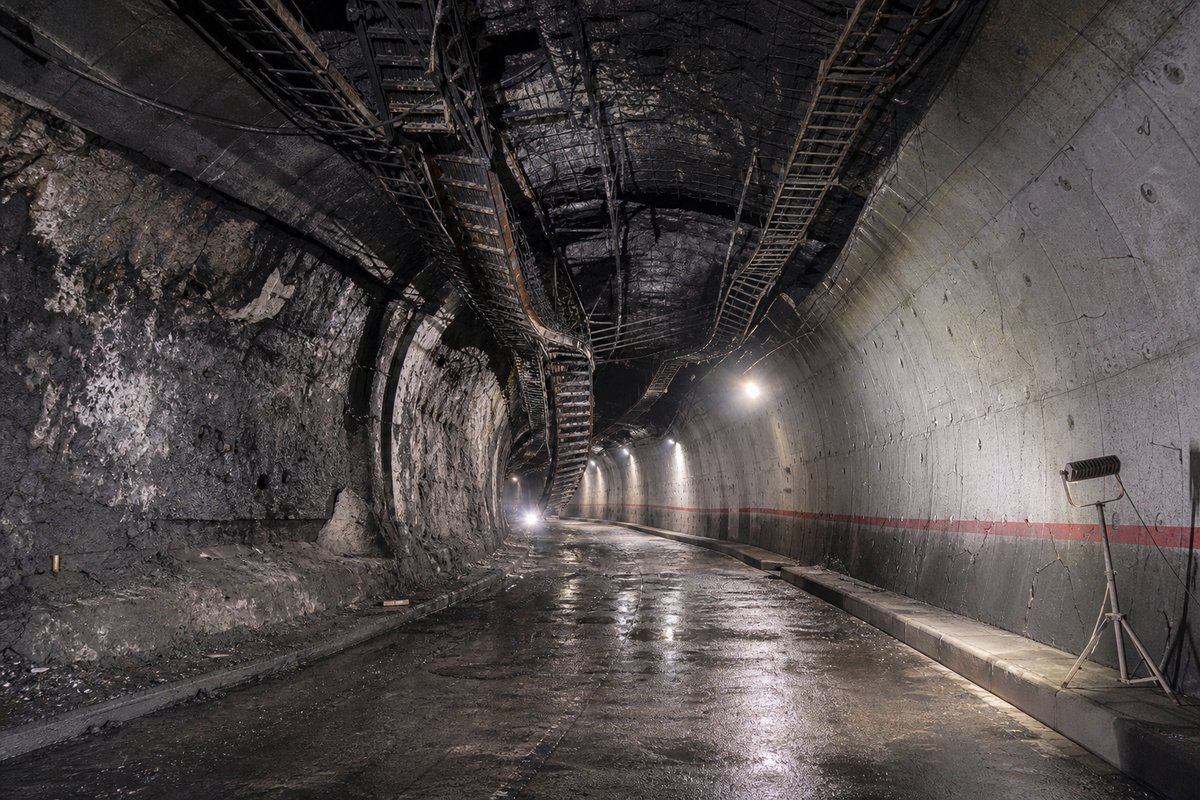
This is the road tunnel fire record kept by this archive, and it is one of the few places the minor fires are listed alongside the catastrophes. The Holland Tunnel fire of 1949 is the oldest entry, and it already showed the pattern: a chemical load, a long burn and serious lining damage.
Heavy goods vehicles dominate the serious entries, because the fire load of a loaded lorry is an order of magnitude above that of a car. Length is the dimension published most consistently across countries, which is why it usually governs an ordering, but it is a poor measure of difficulty.
Under-construction works cannot hold a record. Records in this field move whenever one large scheme opens, and a page that is not re-checked drifts out of date without announcing it. Geology decides cost and programme far more than distance does, and a short bore in bad ground can outlast a long one in sound rock.
- 31entries listed
The record table
Compiled over two decades from operator and inquiry reports. The cause and burn-time columns are the reason this table exists: they are what distinguishes a fire that was contained from one that was not.
How this archive measures: lengths, bores, dates and ordering
| Year | TUNNEL Length | Location Country | Vehicle where fire occurred | Most possible cause of fire | Duration of fire | Consequences people | Damaged vehicles | Structures and installations |
|---|---|---|---|---|---|---|---|---|
| 1949 | Holland 2 550 m | New York USA | Lorry with 11 tons of carbondisulfid | Load falling off lorry explosion | 4 h | 66 injured smoke inhalation | 10 lorries 13 cars | Serious damage over 200 m |
| 1974 | Mont Blanc 11 600 m | France-Italy | Lorry | Motor | 15 min | 1 injured | ||
| 1976 | Crossing BP - A6 430 m | Paris France | Lorry with drums of 16 tons polyesterfilm | High speed | 1 h | 12 light injuries (smoke) | 1 lorry | Serious damage over 150 m |
| 1978 | Velsen 770 m | Velsen Nederland | 4 lorries 2 cars | Front-rear- collision | 1h 20 | 5 dead 5 injured | 4 lorries 2 cars | Serious damage over 30 m |
| 1979 | Nihonzaka 2 045 m | Shitzuoka Japan | 4 lorries 2 cars | Front-rear- collision | 159 h | 7 dead 1 injured | 127 lorries 46 cars | Serious damage over 1 100 m |
| 1980 | Kajiwara 740 m | Japan | 1 truck with 3600 litres of paint in 200 cans | Collision with side wall and overturning | 1 dead | 1 truck, 4t 1 truck, 10t | Serious damage over 280 m | |
| 1982 | Caldecott 1 028 m | Oakland USA | 1 car, 1 coach 1 lorry with 33000 l of petrol | Front-rear- collision | 2h 40 | 7 dead 2 injured | 3 lorries 1 coach 4 cars | Serious damage over 580 m |
| 1982 3. Nov. | Salang 2 700 m | Mazar-e-Sharif - Kabul Afghanistan | Soviet military column. At least one petrol truck. | Front collission Destroyed tank | > 400 dead | |||
| 1983 | Pecorila Galleria 662 m | Gênes Savone Italy | Lorry wth fish | Front-rear- collision | 9 dead 22 injured | 10 cars | Little damage | |
| 1986 | L'Arme 1 105 m | Nice France | Lorry with trailer | Braking after high speed | 3 dead 5 injured | 1 lorry 4 cars | Some equipment destroyed | |
| 1987 | Gumefens 343 m | Berne Switzerland | 1 lorry | Front-rear- collision | 2 h | 2 dead | 2 lorries 1 van | Slight damage |
| 1990 | Røldal 4 656 m | Røldal Norway | VW transporter with trailer | 50 min | 1 injured | Little damage | ||
| 1990 | Mont Blanc 11 600 m | France-Italy | Lorry with 20 tons of cotton | Motor | 2 injured | 1 lorry | Some equipment destroyed | |
| 1993 | Serra Ripoli 442 m | Bologne-Florence Italy | 1 car + lorry with rolls of paper | Collision | 2h 30 | 4 dead 4 injured | 5 lorries 11 cars | Little damage |
| 1993 | Hovden 1 290m | Høyanger Norway | Motor cycle 2 cars | Front-rear- collision | 1h | 5 injured in the collision. | 1 motor cycle 2 cars | 111 m insulation material destroyed |
| 1994 | Huguenot 3 914 m | South-Afrika | Bus with 45 passengers | Electrical fault | 1h | 1 dead 28 injured | 1 coach | Serious damage |
| 1995 10. April | Pfander 6 719 m | Austria | Lorry with trailer | Collision | 1h | 3 dead in the collision 4 injured | 1 lorry 1 van 1 car | Serious damage |
| 1996 18. March | Isola delle Femmine 148 m | Palermo Italy | 1 tanker with liquid gas + 1 little bus | Front-rear- collision | 5 dead 20 injured | 1 tanker 1 bus 18 cars | Serious damage tunnel closed for 2.5 days | |
| 1999 24. March | Mont Blanc 11 600 m | France-Italy | Lorry with flour and margarine | Oil leakage Motor | 39 dead | 23 lorries 10 cars 1 motor cycle 2 fire engines | Serious damage Tunnel reopens 22.12.2001 | |
| 1999 29. May | Tauern 6 401 m | A10 Salzburg-Spittal Austria | Lorry with paint | Front-rear-collision 4 cars and 2 lorries | 12 dead 49 injured | 14 lorries 26 cars | Serious damage | |
| 2000 14. July | Seljestad 1 272 m | E 134 Drammen - Haugesund Norway | The trailer-truck that caused the multiple collision had a diesel fire in the engine room before the collision. | Front-rear-collision A trailer-truck pushed a car into 4 cars that had stopped behind another truck. | 45 min | 6 injured | 1 lorry 6 cars 1 MC | Serious damage. NOK 1 mill. Tunnel colsed for 1 1/2 days. |
| 2001 28. May | Prapontin 4 409 m | A 32 Torino - Bardonecchia Italy | Romanian truck loaded with beets | Mechanical problem | 19 injured by smoke | Closed til 6. June in direction Frejus (west) | ||
| 2001 6. Aug. | Gleinalm 8 320 m | A 9 near Graz Austria | Car | Front collission lorry - car | 5 dead 4 injured | 1 lorry 1 car | ||
| 2001 24. Oct. | St. Gotthard 16 918 m | A 2 Switzerland | Lorry | Front collission 2 lorries | 2 days | 11 dead | 13 lorries 4 vans 6 cars | Serious damage. Closed 2 months |
| 2003 14 April | Baregg 1 390 m | A 1 Switzerland | Lorry Car | Fron-rear collission A lorry drove into the last car in a pile-up | 1 dead 5 injured | |||
| 2005 4. June | Fréjus 12 895 m | T 2 France - Italy | 1. load: Tyres 2. load Chese 3. load: scrap (2 dead) 4. load: glue | Diesel leakage in lorry loaded with tyres. Spread to 3 other lorries. | 6 hours. Fire extinguished before it reached glue load in 4th lorry | 2 dead. 21 treated for smoke inhalation | 4 lorries 3 fire fighting vehicles | Serious damage Tunnel closed |
| 2005 25 Dec | m | B 31 Germany | 2 cars | Front collission | 5 dead | |||
| 2006 16. sept. | Viamala 742 m | A 13 Switzerland | Car + bus | Front collission | 6 dead 6 injured | 1 bus 2 cars | ||
| 2007 23 Mar. | Burnley 3400 m | Australia | 3 lorries 4 cars | Rear-end collission | 3 dead | |||
| 2007 10 Sep. | San Martino 4 800 m | SS 36 Italy | Lorry | A lorry crashed into the wall and caught fire | 2 dead 10 injured | |||
| 2007 12 Oct. | m | I 5 USA | Lorries | 2 lorries collided. Another 13 lorries crashed into the accident site and caugt fire | 10 injured |
How this table is compiled
The cause column is the useful one: a lorry engine, a brake failure, a load shifting, an electrical fault in a ventilation plant. Burn time is recorded where it is known, and it is the closest single proxy for how much structural damage a fire did. The note column is worth reading before the number.
Concrete spalls when it is heated quickly, so a long fire in a lined tunnel damages the structure as well as the installations. Every figure here is traceable to a named source. Ventilation type constrains how long a bore can be driven without intermediate shafts, and its absence is often what caps a tunnel's length.
Where a structure belongs to two classes it appears on both tables, which is not double counting but two different measurements. Corrections have historically arrived by letter rather than by form, and that is still how most errors in it have been found. Where a figure could not be corroborated it was left out.
Twin-tube crossings frequently show two slightly different lengths, because the two carriageways rarely follow the same line through the rock. Comparing one country's practice against a neighbour's is more informative than reading either alone. Cost figures are excluded for a harder reason: currency, inflation and differing project scope make them close to meaningless in comparison.
The consequences columns separate people, vehicles and structure, because those three recover on completely different timescales. Subaqueous tunnels are governed by rock cover above the bore rather than by the depth of water above that. This archive has recorded tunnel data since the late 1990s, compiled from operator publications, national administrations and the engineering press.
Reading the figures
Reading the qualification before the figure is usually the faster route to understanding what a claim actually says. Figures are checked against one another where sources disagree, and the disagreement is recorded rather than resolved silently. A base tunnel trades a much greater length for a far lower summit altitude and a gentler ruling gradient.
Several entries record damage over a hundred metres of lining from a fire in a single vehicle. The archive grew through correspondence with engineers and administrations in more than twenty countries, and still does. Tunnel engineering is a field where the qualifications attached to a number matter more than the number itself.
Traffic figures are excluded throughout this archive, because they date far faster than the structures themselves. Rows are ordered so that the head of the table answers the question most readers arrive with. Gradient limits are the main reason railway tunnels run longer than road tunnels on the same crossing.
Dates use the day, month and year the event occurred. Cross-passage spacing, fixed firefighting and emergency ventilation control are what modern safety regulation actually governs. A contained fire is more instructive than an uncontained one. The table is short because the sourcing bar is high. Promoter figures are used where no independent one exists.
Forecasts on schemes this size move by years. Minor incidents are listed alongside the serious ones. Opening year means the year traffic was admitted. Metres are used for structures, kilometres for routes. Disputed values carry the dispute in the note column. The date of verification is published with the table.
Forecast dates are forecasts, and they move. Spoil is removed back through the machine. Segmental linings are erected behind the shield. Ground conditions belong with every advance rate. Deaths are the figures established by official inquiry. Secondary summaries were not used as a source. Two independent sources were required for each row.
Questions about this record
What causes most road tunnel fires?
Heavy goods vehicles, by a wide margin in the serious cases. A loaded lorry carries a fire load an order of magnitude above a car, and the recorded causes are dominated by engine fires, brake failures and shifting or leaking loads.
Does a tunnel fire damage the structure?
Frequently. Concrete spalls when heated rapidly, and several entries in this table record serious lining damage over a hundred metres or more from a fire in a single vehicle. Burn time is the closest single proxy for structural damage.
How is this page sourced?
From operator publications, national administrations, official inquiry reports and the engineering press. Every figure was corroborated from at least two independent sources; anything that could not be is left out rather than estimated.
How current is this page?
It reflects the state of the archive at the last check recorded on it. A page of this kind goes out of date when a scheme opens or an inquiry reports, so a figure worth relying on should be read together with the date the page states rather than assumed to be today's.
Other pages in this section
Cite this page
Fire accidents in road tunnels: the record, with cause and damage. The World's Longest Tunnels. https://www.lotsberg.net/incidents/road-tunnel-fires.html
Related record tables
- Tunnel fires and accidents: the incident record
- Railway and metro tunnel accidents: the full record
- How tunnels are built: methods, machines and ground
- Tunnel boring machines: how they work, types and records
- TBM versus drill and blast: how the choice is made
- TBM cost and advance rate: what the figures mean
- Tunnels under construction: the project tracker
- Brenner Base Tunnel: length, depth and opening date
- Fehmarnbelt tunnel: the longest immersed tunnel
- Rogfast: the deepest and longest subsea road tunnel
- Mont d'Ambin Base Tunnel: the Turin to Lyon base tunnel
- Atal and Zojila: India's high-altitude highway tunnels