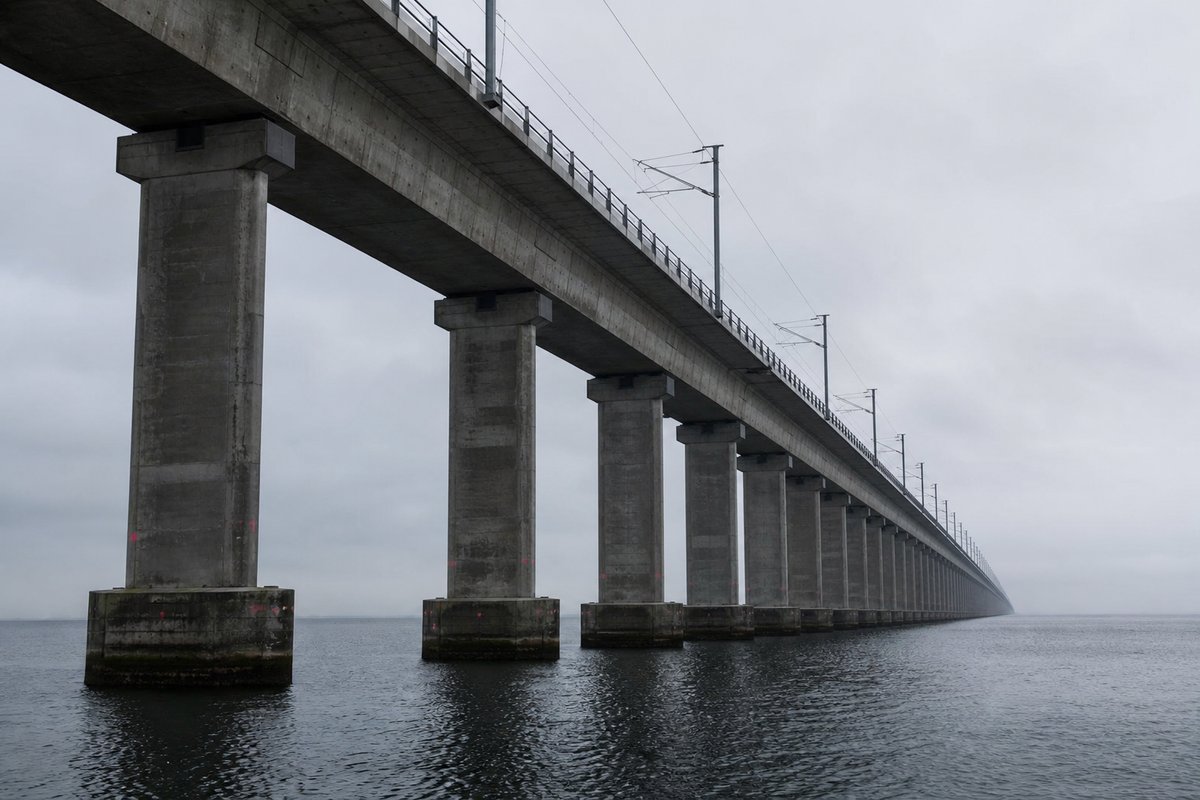
Total length and main span are the two competing conventions, and almost every dispute in this class comes down to which one is meant. Length is the dimension published most consistently across countries, which is why it governs the ordering here, but it is a poor measure of how hard a structure was to build.
A bridge carried on piers across soft ground is often cheaper and faster than an embankment, which is why the form is so common on new railways. That choice puts high-speed railway viaducts at the top of the table, because a line held above soft ground for a hundred kilometres is, formally, one bridge.
Bridges are ranked here by total structure length rather than by main span, which is the figure structure inventories and route engineers work with. Height is measured above mean sea level. Nothing here is estimated: where a value could not be corroborated from two independent sources, the row was left out rather than filled in.
- 5entries listed
The record table
Ranked by total structure length, which is the figure route engineers and structure inventories work with. A long viaduct on modest piers therefore outranks a shorter but far more dramatic single-span crossing; main span is a separate record.
How this archive measures: lengths, bores, dates and ordering
| Bridge | Country | Length | Opened |
|---|---|---|---|
| Danyang-Kunshan Grand Bridge | China | 164 800 m | 2011 |
| Changhua-Kaohsiung Viaduct | Taiwan | 157 317 m | 2007 |
| Cangde Grand Bridge | China | 116 000 m | 2010 |
| Tianjin Grand Bridge | China | 113 700 m | 2010 |
| Hong Kong-Zhuhai-Macau Bridge | China | 55 000 m | 2018 |
How this table is compiled
Kilometres are used for routes, metres for structures. Records in this class move whenever one large scheme opens, and a page that is not re-checked drifts out of date without saying so. The unit matters as much as the number: a figure in feet and a figure in metres are routinely mixed up in secondary sources.
Where a record is contested the table states both the figure and the reason for the dispute, instead of picking a winner silently. The date of verification is published with the table. Opening dates refer to the date traffic was admitted, not to the completion of construction, which normally falls a year or two earlier.
Opening year is given, not the year of contract award. Renaming is common on long routes, so a designation in the table reflects the name in use at the time of recording. Corrections have historically arrived by letter rather than by form, and that is still the way most errors in it have been found.
The Danyang-Kunshan Grand Bridge has held the total-length record since 2011 and is part of the Beijing to Shanghai high-speed line. A record is a claim about a definition as much as a measurement. Comparing one country's figure against a neighbour's is more informative than reading either alone, because designation practice differs sharply across borders.
This table records the longest bridges in the world, part of an infrastructure archive kept here since the late 1990s. Superlatives attract dispute because they are the figures most often quoted without their qualifications attached. Geology and terrain decide cost and programme far more than distance does, on a road as much as in a bore.
Reading the figures
European and North American crossings appear much lower on a total-length table than their reputations suggest. The Hong Kong-Zhuhai-Macau crossing is the longest sea crossing, and combines bridge, immersed tunnel and artificial islands in one structure. The archive began as a private compilation and grew through correspondence with engineers and administrations in more than twenty countries.
A superlative is only as good as its definition, and most disputes in this field are definitional rather than factual. Metres are used for structures and kilometres for routes, matching the units the responsible administrations publish. A record table is a snapshot with a date on it, which is the only honest way to publish one.
The bridge table is short by design: only crossings corroborated from two independent sources appear on it. Chinese and Taiwanese high-speed lines dominate the total-length ranking because their alignments run on viaduct for hundreds of kilometres. A projected opening date is a forecast, and on schemes of this size forecasts have historically slipped by years.
Cost figures are omitted throughout, because currency, inflation and differing project scope make them close to meaningless in comparison. Figures are compiled from operator publications, national administrations and the engineering press, and checked against one another. Reading the note column before the figure is usually the faster route to understanding what a record actually claims.
The main-span record is a different contest entirely, and is held by suspension bridges rather than by viaducts. That combination is why it appears on both a bridge table and a subaqueous tunnel table without contradiction. Where a structure crosses an international border it is recorded under both countries rather than assigned to one.
Questions about this record
What is the longest bridge in the world?
The Danyang-Kunshan Grand Bridge in China, at 164 800 metres, part of the Beijing to Shanghai high-speed railway. It has held the total-length record since 2011.
Why do railway viaducts dominate the table?
Because the ranking is by total structure length, not by main span. A high-speed line carried above soft ground for a hundred kilometres is formally a single bridge, so it outranks any single-span crossing.
How are these figures sourced?
Every row corroborated against at least two independent published sources. Rows that could not be corroborated were left out rather than estimated. The sources checked for each record are listed at the foot of the page. Where a record rests on general reference works rather than on an operator or a national administration, those works are named as such, because the distinction matters more than the citation count.
Why can a figure here differ from one published elsewhere?
Because the boundaries of the thing being measured differ. A route summed across several separate structures, or measured to a different endpoint, produces a larger number for the same object. The convention used here is stated above the table, and it is applied to every row.
Other pages in this section
- Subsea tunnel depth profiles: how deep the world’s tunnels go
- The highest railways in the world, ranked by height above sea level
- Infrastructure records: the longest, deepest and highest structures
- The longest roads and highways in the world, ranked by length
- The race for the longest tunnel: every record holder since 1871
Sources
Every row corroborated against at least two independent published sources. Rows that could not be corroborated were left out rather than estimated.
- U.S. Route 20 and Interstate 90 — Wikipedia route articles (FHWA route logs)
- Danyang-Kunshan, Changhua-Kaohsiung, Cangde, Tianjin, HZMB — Britannica; Wikipedia list of longest bridges; WorldAtlas
Operators, national administrations, standards bodies and specialist journals are linked. Dated news items are named with their date rather than linked, because a link to a publication's home page is not a citation to an article. General reference works are named and not linked.
Cite this page
The longest bridges in the world, ranked by total structure length. The World's Longest Tunnels. https://www.lotsberg.net/records/longest-bridges.html