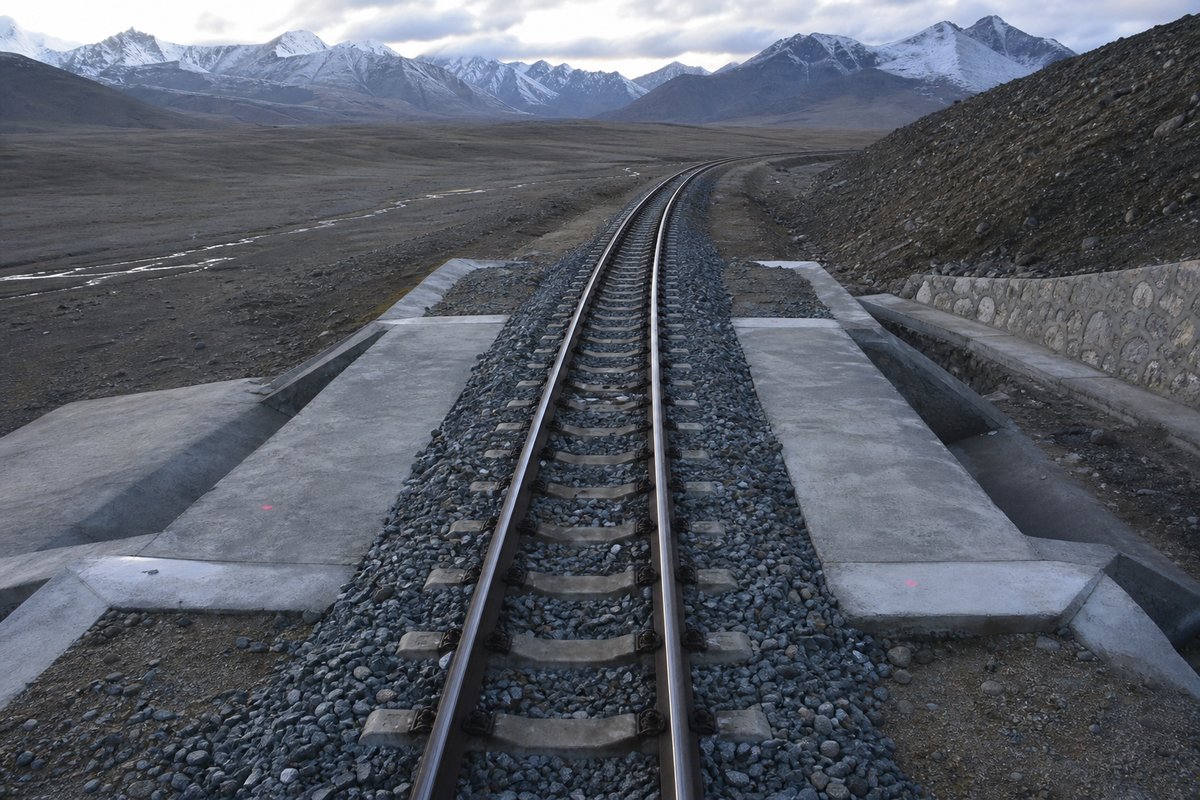
Altitude records are measured at the highest point of the line, not at a portal or a station platform, unless the row says otherwise. Length is the dimension published most consistently across countries, which is why it governs the ordering here, but it is a poor measure of how hard a structure was to build.
The Qinghai-Tibet Railway holds the top of this table by a wide margin, and holds the pass, the station and the tunnel records simultaneously. The unit matters as much as the number: a figure in feet and a figure in metres are routinely mixed up in secondary sources. Height is measured above mean sea level.
Structures are listed under the operator's own name. Nothing here is estimated: where a value could not be corroborated from two independent sources, the row was left out rather than filled in. Records in this class move whenever one large scheme opens, and a page that is not re-checked drifts out of date without saying so.
- 4entries listed
The record table
Ranked by height above sea level at the highest point of the line. Altitude and length are unrelated records: a short line over a pass can reach far higher than a long base tunnel driven low through the same range.
How this archive measures: lengths, bores, dates and ordering
| Feature | Line | Height above sea level | Opened |
|---|---|---|---|
| Tanggula Pass, the highest point of any railway | Qinghai-Tibet Railway, China | 5 072 m | 2006 |
| Tanggula, the highest railway station | Qinghai-Tibet Railway, China | 5 068 m | 2006 |
| Fenghuoshan, the highest railway tunnel | Qinghai-Tibet Railway, China | 4 905 m | 2006 |
| La Galera, the highest tunnel outside Tibet | Central Railway of Peru | 4 781 m | 1893 |
How this table is compiled
Passenger carriages on the Tibetan line are pressurised and supplied with oxygen, which is a rail engineering problem more usually found in aviation. Altitude and length pull in opposite directions: a base tunnel exists precisely to avoid height, so the longest tunnels are among the lowest. Every figure below is traceable to a named source.
The note column is worth reading before the number. Where a record is contested the table states both the figure and the reason for the dispute, instead of picking a winner silently. Opening dates refer to the date traffic was admitted, not to the completion of construction, which normally falls a year or two earlier.
Roughly 960 kilometres of that line runs above 4 000 metres, which is what makes its engineering problem permafrost rather than gradient. Opening year is given, not the year of contract award. Corrections have historically arrived by letter rather than by form, and that is still the way most errors in it have been found.
The engineering problem at height is not gradient or ventilation but permafrost, oxygen and the behaviour of concrete in extreme cold. Renaming is common on long routes, so a designation in the table reflects the name in use at the time of recording. Ranking is by the figure named in the header, nothing else.
Before it opened in 2006 the record had stood in the Peruvian Andes for over a century, on the Central Railway. Comparing one country's figure against a neighbour's is more informative than reading either alone, because designation practice differs sharply across borders. A record is a claim about a definition as much as a measurement.
Reading the figures
This table records the highest railways in the world, part of an infrastructure archive kept here since the late 1990s. Geology and terrain decide cost and programme far more than distance does, on a road as much as in a bore. Superlatives attract dispute because they are the figures most often quoted without their qualifications attached.
Track laid on permafrost has to be kept frozen, so parts of the line are actively cooled rather than insulated. The Peruvian record stood from 1893 until 2006, one of the longest-held records in this archive. A record table is a snapshot with a date on it, which is the only honest way to publish one.
The archive began as a private compilation and grew through correspondence with engineers and administrations in more than twenty countries. A superlative is only as good as its definition, and most disputes in this field are definitional rather than factual. Metres are used for structures and kilometres for routes, matching the units the responsible administrations publish.
Altitude is the one record class in this archive where length is actively unhelpful as a proxy. Reading the note column before the figure is usually the faster route to understanding what a record actually claims. A projected opening date is a forecast, and on schemes of this size forecasts have historically slipped by years.
La Galera remains the highest railway tunnel outside Tibet, and was driven in 1893 through the Meiggs mountain. Structures still under construction appear on their class tables but cannot hold a record until they carry traffic. Cost figures are omitted throughout, because currency, inflation and differing project scope make them close to meaningless in comparison.
Questions about this record
What is the highest railway in the world?
The Qinghai-Tibet Railway in China, which crosses the Tanggula Pass at 5 072 metres above sea level. The same line holds the highest station, Tanggula at 5 068 metres, and the highest railway tunnel, Fenghuoshan at 4 905 metres.
What was the record before Tibet?
The Central Railway of Peru, which had held it for more than a century. Its La Galera tunnel at 4 781 metres remains the highest railway tunnel outside Tibet.
How are these figures sourced?
Every row corroborated against at least two independent published sources. Rows that could not be corroborated were left out rather than estimated. The sources checked for each record are listed at the foot of the page. Where a record rests on general reference works rather than on an operator or a national administration, those works are named as such, because the distinction matters more than the citation count.
Why can a figure here differ from one published elsewhere?
Because the boundaries of the thing being measured differ. A route summed across several separate structures, or measured to a different endpoint, produces a larger number for the same object. The convention used here is stated above the table, and it is applied to every row.
Other pages in this section
- Subsea tunnel depth profiles: how deep the world’s tunnels go
- Infrastructure records: the longest, deepest and highest structures
- The longest bridges in the world, ranked by total structure length
- The longest roads and highways in the world, ranked by length
- The race for the longest tunnel: every record holder since 1871
Sources
Every row corroborated against at least two independent published sources. Rows that could not be corroborated were left out rather than estimated.
- Tanggula Pass and Tanggula station — Wikipedia; Qinghai-Tibet Railway operator material
Operators, national administrations, standards bodies and specialist journals are linked. Dated news items are named with their date rather than linked, because a link to a publication's home page is not a citation to an article. General reference works are named and not linked.
Cite this page
The highest railways in the world, ranked by height above sea level. The World's Longest Tunnels. https://www.lotsberg.net/records/highest-railways.html